Sunday, March 14, 2004


I had planned to give regular updates on developments here in Madrid as the investigation continues into who was responsible for Thursday´s bombing and Spain goes to the polls...but since I arrived just keeping up with the demands of my "real" job has been tough enough.

We´ve been putting in 20 hour days and last night, just as we were calling it a day, a man claiming to be from Al Qaeda admitted responsibility for the attacks, meaning we were up for most of the night covering the development.

To give a sense of the mood here....the sense of solidarity in the immediate aftermath of the attacks has given way to anger and a feeling among many people that Spain´s ruling Partido Popular tried to pin the bombings on ETA when it knew Al Qaeda was most probably blame. The reason for this is that the PP supported the War in Iraq and, some argue, a bombing linked to Spain´s support for the war would have hit its electoral chances. I went to a demo outside the PP headquarters last night in which thousands of people held up banners calling the government mentirosos -- liars -- and urging the government to come clean about who carried out the attacks.

There are two possible outcomes that we´re considering as we plan our post-election coverage:
1) That the PP wins the election and opposition supporters take to the streets again, accusing them of "stealing" the election by hiding the truth about who carried out the train attacks.

2) That criticism of the PP´s support for the Iraq War and the resulting bombings is reflected in the outcome of the vote. If the Socialists win, it could be argued that Al Qaeda influenced the outcome of the election in a major western democracy -- an incredible turn of events.

Saturday, March 13, 2004

It´s been too long and draining a day to begin to write.

I´m tired, soaked and exhausted.

Friday, March 12, 2004

Madrid is a city in shock.

Throughout the city, people have hung Spanish flags covered with a black ribbon on their balconies. Others have hung out banners proclaiming "ETA NO."

The scale of yesterday´s attacks still hasn´t fully sunk in.

Madrillenos will show their disgust at 1900 local time tonight when a mass demonstration is held near Atocha station, the site of the explosions. I´ll be there. There will also be demos at many other Spanish cities.

More later.

Thursday, March 11, 2004

I'll be on the 0720 to Madrid in the morning. This story's got a long way to go yet.

From the start, the extent and scale of the this morning's bomb attacks made many of us suspect that terrorists other than ETA, or working alongside the Basque separatists, must have had some involvement.

It's still too early to say who was behind the attacks but there are several competing theories:

1) A crack down by the authorities has given birth to a new, younger and more bloodthirsty leadership within ETA, which is more prepared to use indiscriminate force (perhaps "inspired" by the likes of Al-Qaeda.)

2) The blasts were a joint operation between ETA and Al-Qaeda, the two organisations forming an alliance in order to cause mass destruction.

3) The blasts were the work of Al-Qaeda alone -- the co-ordinated explosions, Spain's support for the War in Iraq and the fact that AQ cells have been uncovered in Spain in the past all lend weight to this theory.

Of course, if it could happen in Madrid it could happen anywhere in the world. Britain's police and intelligence agencies must be increasingly nervous.
Looks like I'm on the first flight to Madrid tomorrow morning to pick up on the train explosion story.

More when I get there...
My comments yesterday on the disability issue have prompted a flurry of e-mails, the most eloquent and thought provoking of which came from Bruce, a below knee amputee in San Francisco.

The general thrust of his e-mail -- GET OVER IT!!

I may not agree with every point you make, Bruce, but I thank you for making them.

Here's an excerpt:
"I don't so much consider myself disabled as I do inconvenienced. But technically, we are disabled. That's it.

"Look at the definition in your questionnaire: adverse effect...significant...long term. Let's see--yes, it's adverse--besides the parking space and the sick humor value, there aren't any benefits. As you correctly pointed out, it's definitely long-term. I suspect your quibble is with significant--sorry to tell you this mate, but without our prostheses we're reduced to acting like lopsided kangaroos.

"We may go through one or more days giving it hardly a thought. However, we still have to put on the leg and use whatever coping strategies we have developed to deal with our altered appendages. Then, at regular intervals we have to haul the leg in for maintenance or replacement.

"I've tried to come up with a really memorable nomination for amputee of the week, and I still might someday. But for now, I would like to nominate the "average, every-day amputee" (sort of like the Unknown Soldier). These are the folks who deal with limb loss every day, largely unheralded and unnoticed. For every dramatic amputation story with its resulting notoriety there are thousands of men, women, and children who deal with it and move on with their lives."
Thanks to Alex and Lynn for this link.

If the US military wants to know what landmines do to peoples' feet they needn't blow up dead bodies. They can just call me and I'll tell them -- they do this.

Wednesday, March 10, 2004

This is a story I'm looking at with the guys from MAG.

We're thinking of travelling from Zambia to Angola later in the Spring to follow the journey of refugees from transit camps to their home villages, which have been cleared of landmines. The trip will be for a half hour documentary for the World Service.

There are still lots of issues to sort out -- but watch this space.


Ah, it's the old disability question again.

In my work inbox this morning I received an e-mail inviting me to complete a "Disability Survey" (I think it was sent to everyone -- I wasn't being singled out because I'm a gimp.)

Here it is in full:

The DDA defines disability as ‘a disability or impairment that has an adverse effect on your ability to carry out day-to-day activities, is significant and is long term’. According to this definition do you consider you have a disability?

No Yes

If NO, please return this questionnaire now.

If YES, please indicate with an ‘x’ the appropriate disability category (if the significant effects of your disability fall into more than one category please ‘x’ all the relevant boxes) and return the form.

If you are unsure whether you are covered by the above definition(s) please contact the Disability Employment Advisor. If you have any access requirements (e.g. adapted equipment, special software, ad-hoc facilitation, etc) or need help dealing with Access to Work etc., you can contact the Access Unit.

Thank you for completing this questionnaire. If you have any queries, please email 'disability survey'.


So how do I respond?

I have a foot missing. It's "significant and long term" (unless I wake up one morning to find it's grown back in the night). But does it have "an adverse effect on my ability to carry out day-to-day activities?" Not really. I just get on with it.

So back to the core question. "Do you consider you have a disability?"

I can only answer no.

I could, of course, ring the Disability Employment Advisor but frankly the idea of phoning someone to ask them whether I have a disability seems absurd.

Or maybe I'm just afraid he'll say that I have.

Tuesday, March 09, 2004

Word has reached me that this blog has been barred by the Iranian authorities.

Can anyone confirm this?

Looks like that's my chances of getting another visa out of the window...
A sign of the much-feared clampdown on freedom of speech following the election win by Iran's hardliners? Probably still too early to say:
CNN: Hardline vigilantes disrupt women's rally in Iran
In a change of tack, the British Medical Association has said today that there is "very little potential" for Genetically Modified food to produce harmful health effects and has called for an end to "the hysteria" it says often surrounds the GM debate.

That's it, then -- doctors say GM food is safe and opposition to GM crops is just Flat Earth-ism, right?

Not quite.

The GM debate is as much about economics as it is about health.

The food and seed industry, worth around $2000 billion a year, represents a huge source of profits for corporate interests.

Patenting the world's food supply by genetically modifying seeds so that they cannot be saved by farmers and must be bought anew each year means a handful of companies -- principally Du Pont, Pharmacia (Monsanto), Syngenta, and Advanta -- will tighten their hold on the worldwide food chain, making farmers in developing countries increasingly dependent on foreign firms.

As one rice farmer in the Philippines puts it: "‘If seeds are patented, it’s like cutting off a farmer’s arm since you are removing the farmer’s freedom to choose seeds and preserve them.’" (Source: New Internationalist)

(Genetic Resources Action International, ActionAid and Genewatch have much more on this.)
Thanks to Alex for this tale about a one-handed golf ace -- just don't ask him what his handicap is.

Monday, March 08, 2004

Tragic news of another journalistic casualty, this time in Haiti.

RSF has more on the story here.
Jim's documentary about Iran-born photographer Zahra Kazemi, which was shown on BBC World over the weekend, wins plaudits from Hoder, who describes it as "very well-written, coherent, good-looking, fair, and insightful."

He's right, you know.

Sunday, March 07, 2004

AP reports that the man who oversees the cadaver program at the University of California, Los Angeles, has been arrested on suspicion of grand theft, but -- and here's the kicker -- "authorities would not say what he is accused of stealing."

I think we can guess.


Top class telly tonight in the form of live coverage from Crufts.

I sat transfixed for the full two hours on BBC2 but was disappointed when the skinny old whippet won.

I was rooting for the Bichon Frise.


One of my most treasured possessions is a Kinky Friedman lucky plectrum.

It was given to me by the Texas Jewboy himself after a show at the Borderline a few years ago, with the guarantee of good fortune within 48 hours. The Kinkster assured me it was the very same pick used by Hank Williams when he wrote "Kawlija" -- and I believe him.

I'm therefore delighted to learn that Kinky is running for Governor of Texas, promising "I will not kiss babies. I'll kiss their mothers."

C&W legends Willie Nelson and Dwight Yoakam have pledged their support and magicians Penn and Teller have promised to make any opponent disappear.

He's a dead cert.

Meanwhile, anyone wishing to stump up the $36 to ordain me as an Honorary Texas Jewboy will earn an eternal place in my heart and a big up on my blog.
There's a good reason why my blogging has been so light over the past week -- I've moved house....or rather my house was moved for me by the removal men while I was in Iran.

I've got cardboard boxes piled sky-high all over the place and I can't find a thing. Miraculously, though, both the broadband connection and the Sky satellite TV hook-up were moved over without a hitch so at least I can watch television and surf the internet as I sit in my empty living room staring at four bare walls.

I've spent the week sawing, sanding, drilling, plastering and painting. Four days last week were spent in the attic putting boards down and fitting lights -- hence, there's now enough fibreglass trapped in my nostrils to insulate a mansion. I also managed to fill a skip to overflowing with the junk the previous owners had left behind.

It's going to be months before the new place feels like home. Still at least its got a little garden and -- once the decorators have been in -- a study.

If I can find my camera amid all the boxes I'll upload some photos tomorrow.

Friday, March 05, 2004

Former Khmer Rouge head of state Khieu Samphan launches the latest salvo in his attempt to avoid prosecution by the planned U.N-backed genocide trial for Cambodia.

In a book just published Samphan admits he knew ome of the suffering taking place in the country but insists there was nothing he could do to intervene against the Communist party machinery.

Reuters: Ex-Khmer Rouge leader launches defence in new book

Wednesday, March 03, 2004

Thanks to Sherine for flagging up this article in Salon about Iranian bloggers.

It's not a great piece -- I suspect it was written in the US rather than Tehran and there's not a single quote from the very bloggers the article's about.

Still, it's an accessible -- if not particularly comprehensive -- overview of the Persian blogging phenomenon.


After 58 years and around 3,000 programmes, Alistair Cooke has finally read his last Letter From America, bringing to an end the world's longest running speech radio show.

Not bad considering LFA was originally intended to last only 13 weeks.

One can only assume that 95-year old Cooke is not long for this world. He's weathered decades of speculation about the future of the programme -- why else would he choose to bow out now if not because of increasingly poor health.

Tuesday, March 02, 2004

Been there, done that story four months ago. Not a bad piece, though:
Reuters: Girl power finds foothold in Cambodia's minefields

Meanwhile, mine experts from a number of countries are meeting in Jordan do discuss how best to prioritise mine clearance programmes:
Jordan Times: Experts say landmine threat hinders socio-economic development

Monday, March 01, 2004

Apologies for the lack of updates over the last couple of days.

The two day public holiday in Iran to mark the shi'a festival of Ashura meant the chances of any stories breaking over the next couple of days seemed slim.

This, plus the depressing thought of a birthday without booze, prompted me to head back to London this morning to celebrate the start of my 32nd year at home.

Saturday, February 28, 2004

A brief flurry of excitement in the office this afternoon after Iranian state radio's Pashto service reported that Osama Bin Laden had been captured in a tribal area of Pakistan.

In an attempt to get to the bottom of the storty we called IRNA's Pashto section.

The conversation went something along the lines of:
"Can you tell us more about your story about Osama Bin Laden being captured?"
"Well, you know, this is an old story. We reported that he'd been captured a year ago. I have very good sources in the area and they assure me it's true."
"If Bin Laden has really been captured why isn't IRNA's Farsi service broadcasting the news? Why is it only the Pashto service?"
"I don't know. Maybe they don't think it's an important story."

It's possible that IRNA thinks the capture of the world's most wanted man doesn't meet its criteria for an Important News Story -- but I think it's far more likely that they realise it's a crock of shit.

It's not quite the same as broadcasting as fact a rumour that you've just been told by someone down the pub (not that there are any pubs in Iran) -- but it's not a million miles away.
Following my posting a few days ago about the poor quality of canapes at the British Embassy I've received an e-mail from Karen, a British ex-pat living in Tehran.

She runs a catering company here -- Karen's Spicy Kitchen -- and her fare looks far more enticing.

(Do I get commission for the mention?)

Karen's Menu (.doc)
A reminder to anyone wanting to listen to or view the multimedia files that you need to download them to your hard drive first by right-clicking and choosing "save target as..." before you play them.

Friday, February 27, 2004

Human Rights Watch is equally disgusted at President Bush's landmine policy.


This afternoon I made a long awaited journey.

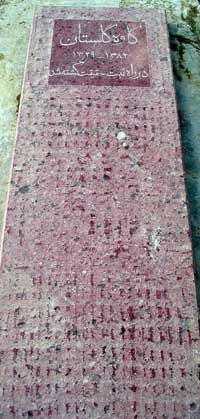
I headed up into the Alborz mountains to the north of Tehran to the village of Afjeh, where Kaveh is buried.

It was an emotional journey. I'd only seen Kav's grave in pictures and to see it with my own eyes brought back all the memories of that day almost a year ago when he died and I was injured.

Even though his name was written on the grave stone, it didn't seem to me like he was there. Kaveh's mother, Fakhri, insists her son's not in the ground. She says he's somewhere up in the snow-frosted mountains surrounding the graveyard.

I think she's right.

I shot some video in Afjeh and have made up a short videoblog because I don't feel like writing about it.

It's 1'34" long and is 626Kb.

Afjeh Videoblog (.wmv)
The US Campaign to Ban Landmines joins the condemnation of President Bush's new mine policy.

"This is another squandered opportunity for US leadership on a crucial arms control and humanitarian issue," says Senator Patrick Leahy of Vermont.

"Worst of all, in a sharp departure from past policy, it says the United States will continue using landmines indefinitely.

"We are by far the most powerful nation on earth, and the world looks to us for leadership on this issue. When we back away from the progress we have pledged to rid the world of these indiscriminate weapons, others will ask why they, with their much weaker armed forces, should stop using them.”


USCBL spokeswoman Gina Coplon-Newfield adds:
"US refusal to join this treaty sets a dangerous, isolationist example to mine-using countries such as Russia, India, and Pakistan that have laid hundreds of thousands of mines in recent years with devastating consequences to civilians."
The Washington Post reports (registration required) on a planned shift in the US's stance on landmines.

The Post says President Bush is to outlaw so-called "dumb" or "inert" landmines -- but allow the unlimited use of what are inappropriately called "smart" mines (BBC News Online also has the story.)

It's a deeply disturbing and utterly cowardly move.

The Bush administration is increasing spending on mine clearance and mine awareness programmes by 50% as a way of deflecting attention from the real issue -- that five years after it was accepted into international law, the USA still has not signed the Ottawa Mine Ban Treaty. That puts America in the same category as every other country in its much-vaunted Axis of Evil -- Iran, Iraq and North Korea (the full list of non-signatories can be found here.)

It would appear that President Bush has abandoned Bill Clinton's plans for a total ban on antipersonnel landmines by 2006.

Any initiative to reduce the use of landmines is, of course, welcome. But if the Bush administration really wants to do something to tackle the worldwide landmine problem it should take the lead and join the 150 countries that have signed the Mine Ban Treaty, which outlaws allanti-personnel mines.

Thursday, February 26, 2004

CIA Director George Tenet touched on the Iranian elections in his testimony before the
Senate Select Committee on Intelligence.


Tenet's assessment:

"With the victory of hardliners in elections last weekend, governmental led reform received a serious blow. Greater repression is a likely result.

"When the new Majles convenes in June, the Iranian government will be even more firmly controlled by the forces of authoritarianism....and with the Majles securely behind the hardliners, we expect to see many of the outlets for political dissent shut down by the clerical regime.

"The prospect of internal violence remains. Hardliners may now resort to new heavy-handedness that produces public outrage and protest.

"Even so, the Iranian public does not appear eager to take a challenge to the streets—in Tehran, apathy is the prevailing mood, and regime intimidation has cowed the populace. This mix keeps the regime secure for now."
My posting a few days ago about the Paykan is the basis for a piece I've just filed for From Our Own Correspondent.

I believe it'll be broadcast on the BBC World Service this Saturday but you can hear it first by clicking on the link below.

The file is 3'52" long and is just under 600Kb.

Audioblog: From Our Own Correspondent (.wma)


Went to a reception at the British Embassy last night to mark the opening of an exhibition of British art at the Tehran Museum of Contemporary Art .

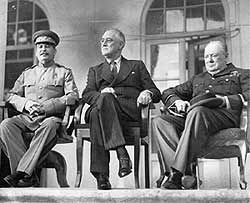
It was at the Embassy, in 1943, that Roosevelt, Churchill and Stalin held the "Tehran Conference" to discuss the opening of a second front in western Europe.

Stalin agreed to an eastern offensive to coincide with the forthcoming western front, and he pressed the Western leaders to proceed with formal preparations for their long-promised invasion of German-occupied France.

On Iran, which Allied forces were partly occupying, they agreed a declaration guaranteeing post-war independence and territorial integrity and promising economic assistance.

Amazing history -- but crap canapes.


BBC News Online reports on the mobile phone frenzy currently gripping Tehran as another tranche of government-issued SIM cards goes on sale.

The mobile network here is a nightmare.

Unlike in many countries you can't just walk into a shop and buy a local SIM card and slot it into your mobile. You have to know someone who knows someone who can get you access to Iran's creaking cellular network.

It took me two days before I managed to find someone willing to rent me their SIM card -- at vast expense -- for the duration of my stay.
Advance notice that the International Campaign to Ban Landmines is holding a publicity drive on Monday March 1st to mark the 5th anniversary of the Ottawa Treaty (coincidentally timed to coincide with my birthday!)

Tuesday, February 24, 2004


Many journalists writing about Iran focus on the obvious problems in this country -- the human rights violations, the restrictions on freedom of expression, the need for women to cover up in public.

All are real – and with up to 70% of Iranians under the age of 30 there’s a huge number of young Iranians yearning for change.

I’ve already experienced, in a very minor way, the petty rules that are an everyday fact of life in Iran.

After dinner in a Persian restaurant a few nights ago I asked for a ghalyan -- a water pipe known in other parts of the Middle East as a shisha or nargila or to westerners as a hubbly-bubbly.

I was told I couldn’t have one – they’ve been banned in public places.

It seems the authorities were worried that young people were having too much of a good time sitting around, chatting and smoking. There was particular concern about the mixing of the sexes. Women were spending too much time lounging around on cushions tooting away on pipes in the company of men. Something had to be done.

About six months ago the Amaken -- the government body which regulates restaurants, hotels, cinemas and the like – banned women from smoking a ghalyan. Then, a few weeks ago, they were outlawed completely and indefinitely.

But over dinner last night, I spoke to two Iranian women who gave me a very different perspective on life in modern Iran.

Both are in their 30s and so can remember the early days after the revolution in 1979. Both are well travelled, well educated and internationalist in outlook.

“Things are not perfect now,” one told me, “But they’re a million times better than they were just after the revolution.”

“I remember in the early 1980s, I was out with my sister one day. She climbed over a wall and as she did a tiny strip of her ankle showed beneath her trousers.

“One of the police officers who guards Islamic values immediately came over to her and ordered her to cover up – but she’d only displayed a tiny, tiny bit of flesh – and only for a second.

“That’s what life was like in the early days of the revolution.

“I was living abroad for ten years and finally came back to Iran in 1999. I couldn’t believe how much things had changed. When I left all women wore the full black chador – and all the men had beards.

“When I returned things were much more relaxed. Women only had to wear a hejab – a headscarf – and I was amazed to see clean shaven men.

“People say Iranian society is terrible now – but they should have been here a decade ago.”

My friends pinpointed the start of the relaxation in Iranian society to the election of Mohammed Khatami, the reformist president who came to power in 1997.

But with the reformists beaten in the general election, and Khatami looking increasingly isolated, surely there’ll be another crackdown, I said. On the eve of the elections another two newspapers were shut down by the hardliners – won’t others follow?

“The Conservatives know they can’t go back,” they told me.

“Even some of the hardliners are much more relaxed than they were a few years ago.

“Anyway, they know that if they try to take away the freedoms that we have there’ll be an outcry.”

I hope they’re right.
The Guardian reports on the story that journalists embedded during the Iraq war will be eligible for a military medal -- and reflects the concern I raised yesterday over the ethics of accepting such a gong.

Embedded Guardian journalist Audrey Gillan says she won't be claiming hers.

"I'm not going to take it for a number of reasons," she says.

"One of them is I'm not a soldier, I'm a journalist. I was there as an independent witness for the Guardian, not for the government."

Quite so.
I came face to face with Iran’s labyrinthine and baffling bureaucracy this morning – but amazingly managed to come away with a result.

With my week-long visa due to expire at midnight, it was vital that I tried to get an extension. I had a flight booked to London via Dubai this afternoon just in case the authorities refused.

My first task was to get a letter agreeing an extension from the Foreign Press department of the scarily named Ministry of Culture and Islamic Guidance.

With that in hand I deposited 100,000 Iranian Rials (the equivalent of about 10 US dollars) into the bank and took the receipt to the Immigration Bureau.

The Immigration Bureau – or Police Department of Aliens Affairs as it’s officially known -- is located on a traffic-clogged street in central Tehran and on a windless day like today the pollution was even worse than usual. I went inside, my eyes watering from the exhaust fumes. I was immediately hit by another eye-watering stink – the overpowering sour smell of stale sweat in the waiting room. Crowds of shabbily dressed men, many of them Afghan migrants working in Iran’s construction industry, were waiting around forlornly.

Some looked as if they’d been hanging around there for weeks.

Signs on the wall in Farsi and English informed women that “TO BE IN ISLAMIC VEIL IS NECESSARY.”

My driver, Nader, guided me effortlessly through the paperwork. I’d have been lost without him. Two forms, a pile of photocopies and a couple of pictures were slipped into a pink folder and added to the mountainous pile of pink folders teetering in a heap behind the counter.

Nader spun the immigration official a line about how the application was very urgent because I was a journalist in a hurry and we took our seats alongside a haggered Afghan flicking worry beads between his fingers.

An hour or so later it was ready….a 2 week extension allowing me to stay in Iran until March 10th.

Monday, February 23, 2004

WHAT DO YOU WANT? A MEDAL?

Thanks to Alex for this story from the Press Association wire.

It says that members of the media embedded with British forces during the Iraq war are to be honoured alongside service personnel with a campaign medal.

The Iraq Medal recognises service in and in support of operations in Iraq from January 20, 2003 -- including the services of MoD-accredited media workers.

That means many of my colleagues who reported on the war will have a nice shiny gong to pin on their jackets.

I, however, as a "unilateral" journalist -- working in Iraq outside the Ministry of Defence's accreditation system -- won't.

Call it sour grapes if you like but I think accepting the same commendation as military personnel crosses a fundamental line. Are we independent journalists -- or are we adjuncts to the armed forces?

Medals and awards are all very nice, but they should come from humanitarian or press freedom organisations -- not the government.
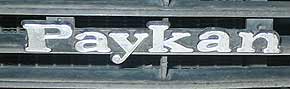
TRAVELS IN THE AXLES OF EVIL -- IN PRAISE OF THE PAYKAN


Breathing in a lungful of Tehran air is a full-frontal assault on the respiratory system.

Your eyes sting. Your nose burns. Your lungs tighten.

A thick petrochemical smog hangs over this city of 12 million people for much of the year, bathing it in a purply-grey haze. At times the pollution is so bad it blocks the view of the Alborz mountains to the north, where wealthy Tehranis escape to ski and take a break from the chronic overcrowding.

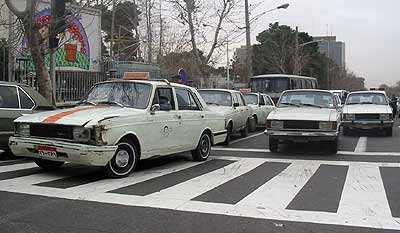
A taxi ride through Tehran can often seem like an afternoon jaunt on the frontline of a war zone.

Cars hurtle in every direction, coughing out exhaust fumes and squeezing through the most impossibly tight gaps in the traffic. Drivers pull out from curbs at wild angles, forcing motorists to swerve suddenly to avoid a collision.

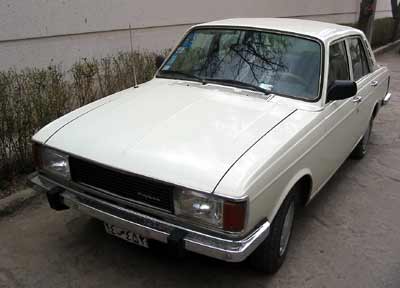
Trying to follow another vehicle through Tehran’s streets is almost impossible because the majority of them are identical. Some 70% of cars on the capital’s roads are battered, white(ish) Paykans.

The Paykan, Iran’s equivalent to the East German Trabant, will look familiar to many British eyes. It’s a locally-made version of the Hillman Hunter, a box-like sedan manufactured in the UK during the 1960s and 1970s.

The Paykan (the word means “arrow” in Farsi) was the first car to be manufactured in Iran, in 1967. Two models were sold at first – the “standard” and the ambitiously named “deluxe.” The range soon expanded to include a Paykan taxi, pick-up and even an automatic model.


Production of the Hillman Hunter ended in Britain in 1979 – but its Iranian brother survived.

Millions of them have rolled off the production line at the state-owned Khodro car plant west of Tehran, providing several generations of Iranians with an affordable, if not particularly luxurious mode of transport.

Pre-revolutionary models are said to be particularly sturdy and surprisingly feisty.

Like workhorse car marques the world over – Skoda, Lada and of course Trabant – the Paykan is the butt of countless jokes. Telling an Iranian friend who’s looking for you in a swarm of traffic that “I’m the one in the white Paykan” is sure to raise a smile. You and every other motorist in Iran, they’ll reply.

Yet the ubiquity of the Paykan has benefits.

Replacement parts are easy to find and any mechanic in Iran can strip one down with his eyes closed.


It seems, however, that the Paykan’s days are finally numbered.

Khodro is looking to the future and has ambitious plans to team up with international manufacturers to build luxury cars. The ancient Paykan is no longer part of its long term strategy.

It is being gradually phased out and the final one will roll of the production line some time after 2005.

However the Paykan’s attractive combination of affordability and reliability means it’ll be many years yet before this unlikely object of Iranian national pride and affection finally disappears from Iran’s streets.

Sunday, February 22, 2004

As I predicted here and here, Ralph Nader has confirmed that he's running for the American presidency.

He told NBC's Meet The Press he'll run as an independent.

It was quite clear from the interview I did with him last month that he'd run, despite receiving thousands of e-mails urging him not to.

It's difficult to be sure whether Nader really wants to challenge the Democrats and Republicans -- or just boost his own ego.

BBC News: Nader announces presidential bid
This afternoon I found a way of bypassing the censorship of Iranian ISPs.

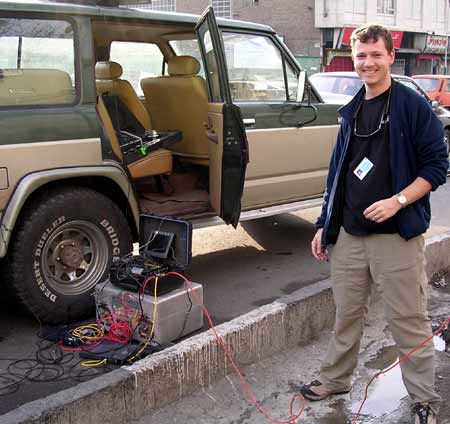
It's through the BGan, a small laptop-like dish that provides high-speed internet access through the Inmarsat satellite network.

We use it to send compressed video files to London without having to pay the high costs involved in buying satellite time from Iranian TV. But it can also be used for normal web-surfing.

it's lightning fast and completely unfiltered.

If only every Iranian could access one.
Tehran blogger Ara e-mails to explain the vagaries of web surfing in Iran.

He writes:

"The list of forbidden sites varies from ISP to ISP, so my ISP, ParsOnline (the biggest ISP in Iran), doesn't block Hoder's site at all currently while other ISPs do.

"I believe it's because of parallel intelligence services in Iran. They are not in sync with each other at all. There's no legally organized list of banned sites, yet if an ISP does not block a site that someone from the various intelligence communities told them to block then that ISP is in serious trouble."
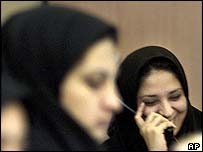
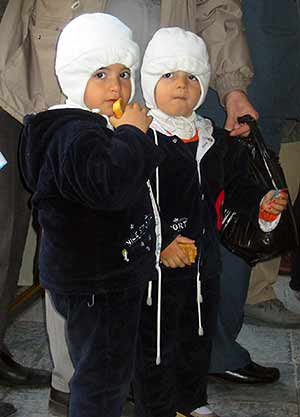
The next generation of Iranian voters:

Success at last on the upload front.....

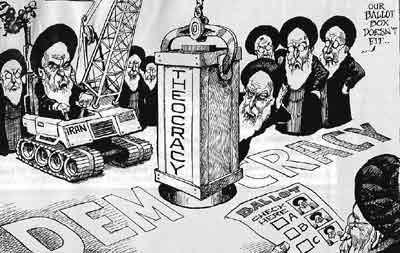
As expected, the hardliners are heading for a sweeping victory in Iran's general election.

What we're seeing is the end of the Reform Era in Iranian politics and the beginning of the Post-Reform Era. The rogressives will now have to build up a new power base and new alliances outside the established political institutions.

Athough the conservatives insist there'll be no "talibanisation" of Iranian society by the emboldened hardliners, it's clear that those who want to liberalise the country will be pushed increasingly to the margins by the clerical establishment.

There are fears in some quarters of a further crackdown on those pushing for political reform now that the hardliners have taken control of another branch of the state -- the parliament, or majlis.

So where now for the reform movement in Iran?

It's a question I discussed with Dr Sadegh Ziba Kalam, a lecturer in Iranian Politics at Tehran University. He says that, with the parliament now in their hands, the conservatives will now turn their attention to next year's presidential election. They'll be looking to take the presidency from the embattled Mohammed Khatami, who came to power in 1997 on a reformist platform.

Audioblog: Sadegh Ziba Kalam Interview (.wma)
Maybe yesterday was a fluke because try as I might I can't seem to be able to upload any multimedia today....and I have a great interview I want you all to hear.

I'll keep trying -- but the connections here are painfully slow.

Saturday, February 21, 2004


Thanks to Jeff Jarvis for the link.

In an e-mail I just sent him I mentioned the fact that I'm keen to do a story about Iranian bloggers while I'm here -- if time and visa extensions allow.

With another two newspapers closed down on the eve of the election for publishing a letter by reformists barred from standing in the election, criticising Iran's Supreme Leader Ayatollah Ali Khamanei, I speculated whether Iran's media is facing another clampdown after the election. With the conservatives set to take charge of the parliament, or majlis, will they be emboldened to crack down on the media -- and will bloggers become an increasingly important news source?

I signed off my e-mail to Jeff by saying that the authorities here can silence the mainstream media -- but will they be able to silence the bloggers?

I may have already found my answer.

I tried to log on to Hossein Derakhshan's site because from the stats it looks like he's also given me a mention. He's an Iranian living in Canada who's done a lot of work promoting and helping his fellow Iranian bloggers.

My browser gave me a stern message -- "THE REQUESTED PAGE IS FORBIDDEN. I tried a proxy server instead. Same message.

I asked my translator, Negar, to tell me more about net censorship. She explained that as well as all porn sites, anything deemed seditious is also blocked by the local ISP.

Iran Filter isn't blocked, though -- presumably because it's in English and therefore can't pollute the minds of Farsi speakers.

If anyone's able to cut and paste Hoder's blog entry about this site and e-mail it, I'd appreciate it.
Working as a journalist here in Iran is a surreal experience.

A staple of broadcast journalism is the “vox pop” – accosting people on the streets and asking them what they think about a particular subject.

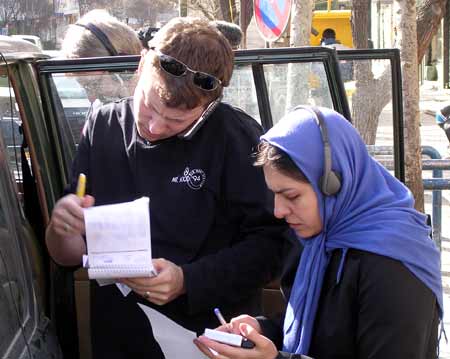
On election day, many of the programmes I work for were asking for voxes so I went down to a nearby polling station with my translator, Negar, to listen to the vox of the populi.

Being able to interview people openly in public places is unusual enough in Iran. But the paranoia of the authorities over it would be laughable, were it not so serious for the ordinary Iranians who have to deal with the invasions of their privacy every day.

As soon as I took out my microphone and started talking to people, a plainclothes intelligence officer sidled up alongside. He didn’t say anything, he didn’t stop us, he didn’t take notes…he just stood there, as if poised to step in should anyone dare to criticise the regime. It was all extremely bizarre – but because we’d been rigorous beforehand in ensuring we had the right accreditation, everything was above board. On any normal, non-election day we’d have been hauled off to the nearest police station – or at the very worst subjected to the breathtakingly pointless questioning and permission checking that makes you want to tear your hair out. For the elections, though, we had our special papers – and no one could stop us.

As the day went on, the constant shadow of the authorities began to feel almost normal. Men in sunglasses followed us from a distance whenever we went. To be fair, I would have been very surprised if they hadn’t.

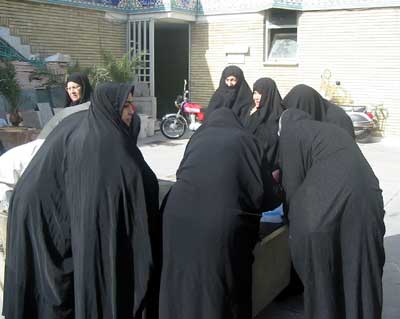
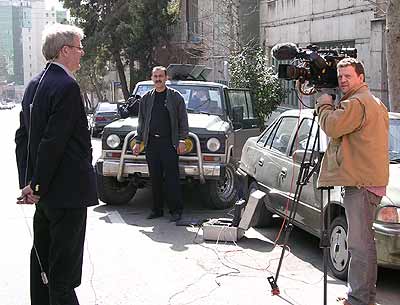
At one point, we turned up at a polling station to do some lives on our videophone, only to find it virtually deserted. As we set up the camera, the police officer on patrol herded up a gaggle of women in black chadors and made them queue outside – to make it look like the Great Iranian Public was itching to cast its collective vote.

At the polling station, I met two sisters who were a dream for me. Not only did they speak good English but they were also poles apart politically – one conservative, the other reformist.

I made them the centrepiece of my election day report, which you can hear here. It’s a .wma file, is 400Kb in size and is 3’18” long.
Veteran Middle East commentator David Hirst, author of the classic work The Gun and the Olive Branch is staying downstairs from the bureau with Jim and is also working out of our office.

Read his latest despatch for the Guardian on the Iranian elections here.
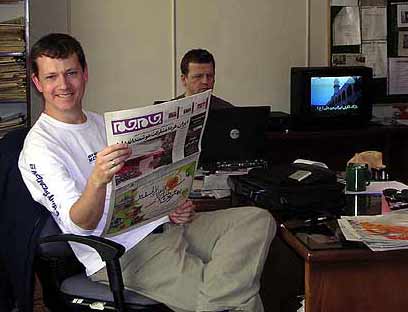
Getting reacquainted with Jim Muir...

I'm quite proud of this -- my first Iranian videoblog, perhaps the first Iranian videoblog. Filmed, edited, encoded and uploaded entirely on location.

It's my analysis of the election results so far and is just over 400Kb in size:

Videoblog: Iranian Election Analysis (.wmv)


The rollercoaster of news stories that have landed in my lap since I arrived here in the early hours of Wednesday morning has meant that it was only on election day that I was finally able to get out and about onto the pollution-choked streets of Tehran to “gauge the mood” – as journalists are fond of doing.

Until then, my picture of modern Iranian society had been a fragmentary one. For me, it was summed up by the behaviour of the bureau’s assistant, Negar.

She arrives at the office every morning dressed in long black coat and modest hejab. As soon as she’s indoors, though, she takes off her headscarf to uncover her hair. Beneath her coat, Negs wears western clothes.

It’s not every day that a foreign journalist with a microphone and a camera can walk up to an ordinary Iranian and ask them what they think about their country’s political system – and simply walk away afterwards.

On any normal day, gauging opinion on the streets of Tehran would instantly attract the attention of one of the many branches of Iran’s security forces – the Revolutionary Guard, the police, or undercover intelligence officers.

But election day for the seventh Iranian parliament, or majlis, was no ordinary day. More than 200 foreign journalists are reporting on the elections – and the authorities are eager to show their country in its best light.

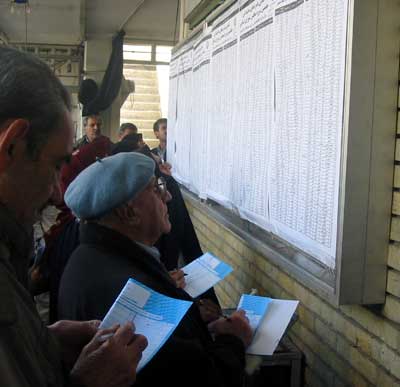
At a polling station in the prosperous suburb of Niavaran, in northern Tehran, voters – and some who have simply turned up out of curiosity or to give moral support to relatives -- were eager to express their views, even if many are less willing to give their names or have their photographs taken.

Long lists of candidates hang are posted along the walls of the polling stations. But the names of many would-be candidates were absent. Prior to the election Iran’s hardline Council of Guardians, an unelected watchdog, banned around two and a half thousand reformist politicians from standing.

The reformists, already under pressure over their perceived failure to fulfil their promises to liberalise Iranian society, decided to boycott the poll.

Many voters followed suit, including translator Bahar Irani.

“The candidates standing only represent about 10% of the population,” she told me.

“If the candidates don’t represent the population then it’s not a real election.”

Bahar Irani had only turned up at the polling station to accompany her sister, Noushid Najafi.

Although blood relatives, the two share very different political views – one a reformist, the other deeply conservative, a fact highlighted by her flowing black chador covering her entire body.

“It’s not because I’ve been tortured or anything like that I’ve chosen to vote,” Noushid said.

“It’s my right to vote, I want to vote, and that’s why I’ve done it.”

For some Tehranis, though, the ideological divide between conservatives and reformists is a side issue.

“All politicians are as bad as each other,” said Zohreh Sadri.

“They only think of themselves and their own wallets – and that goes for those who vote for them as well.

“If the turnout is low it’ll show that the politicians aren’t representing the will of the people.

“The whole election is a sham.”

That’s a sentiment shared by Ali Sami’ee, a 22 year old student.

“We do have a parliament here but as long as there is an unelected body like the Council of Guardians then parliament will basically be powerless.

“Whether we like it or not, the regime will be the overall winner.”

As I left Ali Sami’ee and walked away from the Niavaran polling booth he was immediately approached by a plainclothes intelligence officer and questioned about our conversation.

Old habits die hard in Iran – even on election day.

(A version of this entry can be found here.)

Friday, February 20, 2004

Apologies for the light blogging, which is due to a combination of a piss-poor internet connection and a never-ending workload.

I've been out at polling stations this morning, reporting and gathering material, which will make its way onto the blog once I get time to find a faster net connection.

Thursday, February 19, 2004


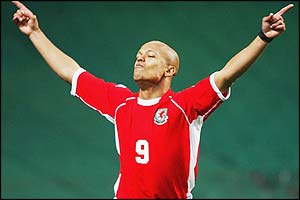
Earnie is God. Fact. He should be canonised without delay.
BBC Sport: Wales 4-0 Scotland
Something completely non-Iran related....as well as watching terrible films on the flight over here I also put together a videoblog from last week's trip to Tenerife.

It's the first one I've edited using Adobe Premiere instead of
Videowave. I found it a much more powerful piece of software, if a little frustrated and complicated to use -- although I'm sure that's just because I'm not completely familiar with it.

So, here's a videoblog shot in the Teide National Park. I've cut out the audio track because it was just the sound of howling wind -- so it's just nice pretty pictures.

Videoblog: Teide National Park (.wmv)
My first day in Iran certainly didn’t turn out as expected.

After a few hours’ sleep I crawled through Tehran’s traffic-choked streets to the BBC’s house-cum-bureau. As our driver, Nadar, inched along I admired the snow dusted Alborz mountains to the north of the city and reflected on the fact that the last time I’d travelled in his 4x4 it was on the way to the hospital in Kifri, my severed foot wrapped in a scarf. Kaveh lay dead on the back seat. It was the most eerie feeling and I chose to sit in the front seat, too spooked to re-enact that fateful drive too accurately.

Coincidently, Nadar is himself a right below-knee amputee. He lost his leg to a mortar round 20 years ago as a soldier fighting in the Iran-Iraq war. But unlike me, he drives a car with a manual transmission – quite a challenge for someone with no feeling and limited movement in their right foot. He’s promised to teach me how to do it.

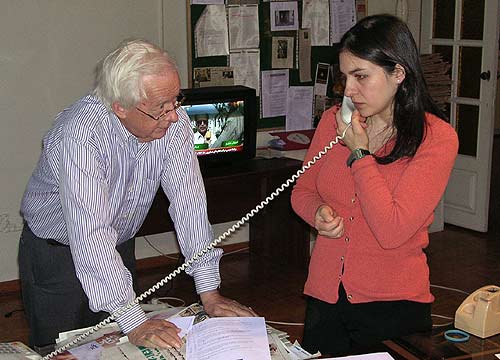
I found the Tehran bureau a relaxed and inviting place to work, a complex of interconnecting open plan rooms cluttered with newspapers, broadcasting equipment and assorted memorabilia. Two framed photos of Kaveh hang above the fireplace, one of them edged with a black ribbon.

A communal kitchen and dining room, shared with correspondents from the Guardian and the Financial Times, gave the place the air of a bohemian alternative magazine rather than the base for some of the Middle East’s most respected journalists.

I didn’t get much of a chance to admire my new surroundings.

No sooner had I unloaded the gifts and supplies I’d brought over from London (including the sausages) than the World Duty Editor rang. A train carrying petrol and chemicals had exploded in Khorasan province, in the northeast of the country. Many were feared dead.

Normally Jim would have immediately set to work – but he was heading out the door to do some crucial filming for our election preview piece. It was left to me, with a wide knowledge of Iran garnered from less than 12 hours in the country, to hold the fort.

As the dead toll rose into the hundreds, the list of requests for live interviews – or “two-ways” as we call them in the trade – grew. World Service, News 24, World TV, Radio 4, 5 Live, even Radio Scotland – all of them wanted updates on what had happened. It continued like this for 12 straight hours, by which time the number of interviews churned out was almost as high as the death toll in Khorasan.

The most tricky was question of the day came from an interviewer who asked me to tell viewers what Iran’s rail infrastructure was like. I could have told him I didn’t have the slightest clue, and that my knowledge of Iran’s rail network was about as extensive as my knowledge of Farsi, but I opted instead for a more diplomatic and non-committal answer.

As a result, no time for photos yet…but rest assured they’ll follow soon.

Wednesday, February 18, 2004


On the flight over here I caught the last half hour of Beyond Borders, the controversial new Angelina Jolie movie about aid workers.

Angelie Jolie filled the screen with all the presence of a shop window mannequin with an allergy to bees.

I can’t recommend it.

For a start it regurgitates every third world stereotype imaginable; oppressed and helpless peasants are brutalised by wild-eyed, crooked-toothed warlords. The “Cambodian” scenes were filmed in Thailand and the “London” scenes certainly weren’t shot in the city I live it. I suspect they were filmed on location in somewhere like Canada, to take advantage of the tax breaks.

But more importantly, it’s a deeply irresponsible piece of film making.

Every major Hollywood release is pirated onto VCDs and DVDs and sold in souks and bazaars from Tajikistan to Taipei. A movie about an aid worker who smuggles weapons in crates full of prosthetic limbs and humanitarian supplies will cause confusion and distrust among the very people the NGOs portrayed in it are trying to help.

Hopefully by now I’ve put you off, but if not look away now if you don’t want me to spoil the ending. It features the oldest landmine cliché in Hollywood. Miss Pouty Lips rescues the love of her life -- renegade doctor Nick -- from bandidos (wild-eyed, crooked-toothed, of course) in war-torn Chechnya, only to step on a mine while running for help. She steps on the device and CLICK! suddenly realises what she’s done. Angelina stands there for a moment, frozen to the spot, knowing that as soon as she moves her foot she’s going to get wasted.

Then -- BOOOMSKI! She lifts her foot and goes up in smoke, leaving a big crater and thick clots of collagen spattered all over the battlefield.

Good riddance. It was a crap film anyway. Can we go to the pub now, please?

Nice dramatic climax but sorry, it doesn’t happen in real life (and I think I’m able to speak from experience, don’t you?). As any mine clearer (or victim) will tell you, landmines are triggered by stepping ON them, not OFF them. The pressure pad on top pushes down a plunger which detonates the explosive charge in the mine and voila – your foot’s bacon.

And Angelina of all people knows that.

I’ll forgive her, however, because she does look spectacular in a sweaty vest.

Tuesday, February 17, 2004

More evidence that all is not well in Athens. Following complaints last week by the Paralympians, The Telegraph (registration required) now reports on rising fears over the steel-and-glass dome at the Olympic Stadium.

The high-tech roof was the source of much concern when I visited the site -- as well as anger that a Spanish architect, Santiago Calatrava, had been chosen to design it rather than a Greek one.

However, roofs (or is it rooves?) are less of a problem for cigar-chomping Arnold Schwarzenegger, who's apparently planning to tear the lid off the state capitol in California so that politicos can enjoy a stogie. As a fan of Cuba's finest export myself it's a measure I heartily endorse.

Meanwhile, in this age of interconnectivity and global communication, the Telegraph also has a delightful story which shows that the human race is still capable of throwing up the odd surprise. In this case it's a newly discovered language spoken only by a few hundred Siberians living along the Chulym river near western Mongolia. Fabulous.
One I've only just picked up on because of last week's holiday; The New York Times says Ralph Nader will decide within the next week or two whether there is enough grass-roots support for him to run for president.

My sense, based on what he said in the interview I did with him a few weeks ago in Washington, is that he'll go for it -- and get nowhere.

Maria Recio of Knight Ridder has more on the possibility of Nader for Prez 2004.


For anyone who travels frequently on business, it's the little things that make a big difference.

Most of my colleagues working in foreign news have a special treat or favourite item they slip into their suitcase. For me, it's Havana cigars. For others it's a certain type of bubble bath, a much-watched DVD or a collection of trashy novels. These little luxuries can mean the difference between surviving a difficult assignment with one's sanity intact and going under.

So it came as no surprise when I got a call from Tehran on a dodgy mobile phone line. It was Jim. "Can you bring me out some vegetarian sausages?" he asked.

But not just any vegetarian sausages.

"I'm addicted to the ones made by Cauldron," he said. "And make sure you get the Lincolnshire variety."

The shopping list went on.

"And some soap. I'm almost out of soap. Something gentle on the skin."

A quick trip to my local Sainsbury's and five boxes of Cauldron Vegetarian Sausages (the Lincolnshire variety) were in my suitcase.

A soothing lather for a dry-skinned Tehran Correspondent I'll pick up at the airport.
Here's The Economist's take on the Iranian elections.


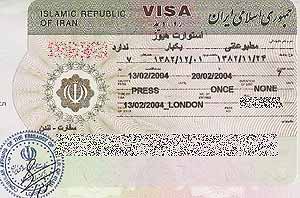
It may just be a single piece of paper with a signature on it but right now it's the most precious thing I own.

It's my sought-after visa for entry into Iran. So far, I'm the only London-based English language BBC journalist to be issued with one, so I'm guarding it with my life.

I fly out to Tehran this afternoon.

Monday, February 16, 2004

Thanks to Steve for this link to a story about a subject very close to my heart:
BBC News Online: 'Shocking' rise in disabled parking abuse

The survey was carried out by the campaign group Baywatch.
Aside from the immediate trip to Iran, another story I'll be covering later this year is the Olympics followed by the Paralympics.

I'm keen to do the Paralympics for personal reasons as much as anything, to see how other amputees and so-called "disabled" people are overcoming their difficulties.

But according to BBC Sport Online, Athens isn't ready to host the Paralympics.

"There is a lot of work still needed, especially with obstacles in the way on the pavements," says the International Paralympic Committee.

I can well believe it. During my recent visit to Athens to see the Olympic venues it was clear that the city's a nightmare for people with mobility problems. We're facing our own problems, too. Our "live position" for TV interviews in the International Broadcast Centre is halfway up a flight of stairs with no lift-- not great if you're trying to get up there in a wheelchair, as many Paralympians will be.

Yet strangely, this IPC press release is more diplomatically worded, painting a very different picture of Athens' readiness for the Paralympics.
Just received the latest security briefing for Northern Iraq, which highlights why my planned trip into Northern Iraq to film a documentary about my accident isn't such a good idea at the moment. It says:

"Information has been received that travel to Erbil and Sulaymaniyah should not be undertaken in the next few days.

Reason for the advisory is that Kurdish groups have given a deadline to the Islamic Party to move out by of those cities by 0900, 9 February. If this does not occur, then there is the possibility that violent confrontations may develop not only in Erbil and Sulaymaniyah but in various locations throughout Kurdistan. Some

Contractor and NGO organizations have advised their local staff and employees to stay home until recalled and informed their non-resident expatriate staffs not to travel the Kurdistan area of Iraq until further notice.


Hopefully the postponement will only be temporary.
And so, after much nail-biting and repeated calls to the embassy, it seems that my Iranian visa has finally been issued, although I won't believe it until I see the stamp in my passport when I go into the office in the morning.

I plan to leave for Tehran on Tuesday and hope to blog as usual while I'm there.

It seems I'm one of the lucky ones. A number of BBC journalists, including some high profile ones, look unlikely to be allowed in.

It'll be an emotional assignment for me. One of the main reasons I want to go to cover the Iranian elections was so I can visit Kaveh's grave and meet his family. Also, it'll be the first time I've worked with Tehran Correspondent Jim Muir since that fateful day in Kifri almost one year ago.

The story itself, however, looks like being something of a damp squib. The right wing Council of Guardians has disqualified more than 2,000 reformist candidates from standing in the election. Even so, disillusionment with the reformists has meant the public's response has been muted.

The belief is that the election will be lacklustre, bordering on farcical, with the expected turnout being put as low as 15% by some commentators. If that turns out to be the case, it'll be bad news for reform-minded Iranians; conservatives may dominate the new parliament and president Muhammad Khatami will be further weakened.

You can follow some of the BBC's Iranian election coverage, including the latest analysis by Jim, here. No western journalist knows Iran better than he.

Talking of which, Jim's documentary on the death in an Iranian prison last year of the photojournalist Zahra Kazemi aired in Britain this evening -- and a compelling and measured piece of work it was too, using Kazemi's life as a prism through which to look at 30 years of Iranian history. Try and catch it if it pops up as a repeat.

Sunday, February 15, 2004

Thanks to Mark for this tale of a ten year old Australian girl who just can't wait to have her left leg amputated.

Go easy with that kitchen knife, Natalie -- amputation is a job that should be left to trained professionals.


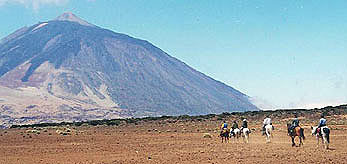
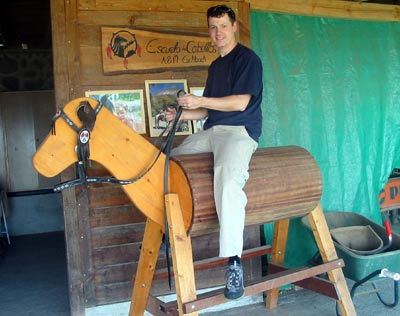
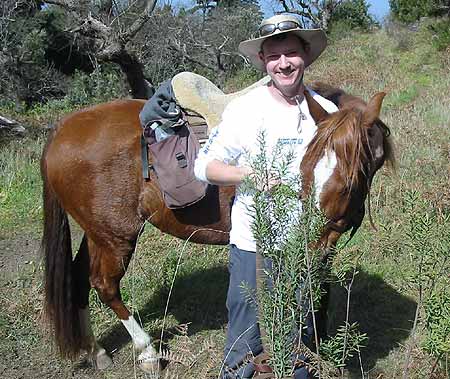
I'm back -- revived, refreshed and reeking of horse shit, from the delightful Finca Verde ranch in the north of Tenerife.

I can't recommend it highly enough -- it's a great place to relax and improve your riding (and the travel agents -- specialist firm In The Saddle also deserve commendation). Finca Verde's owners, Swiss couple Andrea and Markus Eschbach, are delightful and worked hard to make my week on horseback a memorable one.

Their farm, up in the hills near the Teide National Park, is just a half hour's drive from the mass tourism arsehole of the world that is the resort of Puerto De La Cruz (I headed down there one evening to buy a couple of boxes of duty free Havanas and left again as quickly as possible). Even so, it's a world away from the beer-gutted, salmon pink skinned package holidaymaker hell.

Looking down on the rest of the world from their hillside ranch, amid the lemon trees and Canarian pines, I immersed myself in the natural horsemanship techniques pioneered by teachers such as the comically named
GaWaNi Pony Boy (surely a pseudonym) and German instructor, country singer and natty blazer wearer Fred Rai.

Though the Indian riding pioneers are easy to mock, their approach is sound. Indian riding, Andrea explained, is based on a compassionate understanding and handling of the horse. The key is knowing the behaviour pattern of horses and giving clear and consistent instructions. Once the horses are comfortable with you and vice versa, the idea goes, you can do away with painful bits, spurs and whips. The animals will respond to simple, firm commands alone.

It seemed to work. By the end of the week I -- a riding beginner -- was trotting, cantering and guiding my horse as if I'd been doing it for years. The small matter of my artificial leg constantly slipping out of the stirrups was an inconvenience but aside from that I made huge progress.

I'm rushing to get ready for my departure for Iran on Tuesday (of which more later) so there's no time to put together a crafted videoblog. It'll have to wait until I get back. For now, here's a very rough and ready horse's eye view of what hitting the trail in the hills of Tenerife is like. The .wmv file is just under 600Kb in size. To view, right click on the link, save the target onto your hard drive and then open it once it has downloaded:
In The Saddle Videoblog (.wmv)

And some photos:
Teide National Park
Ride 'Em Cowboy!
On The Trail