Tuesday, November 18, 2003


A depressing morning when I came face to face with the banality of evil.

In 1975, the Tuol Svay Pray High School was taken over by the Khmer Rouge and turned into the notorious prison, interrogation centre and torture camp known as S-21.

Between 1975 and 1978 more than 17,000 held at S-21 were taken to the killing fields outside Phnom Penh and executed. Many were bludegoened to death to save bullets.

The Khmer Rouge photographed the inmates as they arrived and the confused, scared and resigned faces of those whose death was assured line the walls of the prison, which is now a museum.

The horrors endured by those penned into the tiny brick or wood cells are unimaginable....chained and shackled to the floor,....manacled to steel beds and tortured and electrocuted, beaten and raped before being driven to the Choeung Ek Killing Field for what must have seemed like a merciful execution.

It's a deeply chilling place.

Read more about the Cambodian genocide here.
The photo story on the female deminers is up and running here on BBC News Online.

Monday, November 17, 2003


An award for this blog...Blogger Forum's Top Site for the week.
The chaps at Blogger Forum say that "Google considers your site important in comparison to other blogs in a one-week period."

I say....hurrah!

Sunday, November 16, 2003


With passport problems behind me, I've been able to turn my attention to more important matters -- like sleeping. Sean and I had planned to head out this morning to work on a story about women who collect spiders and sell them for people to eat -- some are dipped in honey. Yum!

However, a heavy night sampling the underbelly of Phnom Penh put paid to that and we decided to rest up instead.

I did manage to finish off a photo journal for BBC News Online. It'sa day in the life of Seng Somala, the supervisor of Cambodia's only all-female demining team.

We went out with them on Thursday and found them utterly enchanting -- 15 women from their early 20s to their mid 40s, all laughing and joking as they headed out to the minefield to risk their lives. Quite amazing.

I'll be doing a radio piece on them for the week after next, which will run on the Woman's Hour programme.

Meantime, here's an extract from the photo journal:

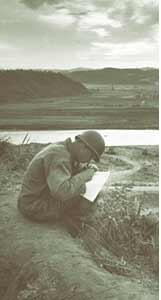
Photo One: My day starts at six o’clock in the morning with a stop off at the market a few miles from the minefield where I work. The 15 women deminers on my team sit down for breakfast and I buy supplies for lunch. It’s always a bit of a rush because it’s important to start work as early as possible, before it gets too hot.

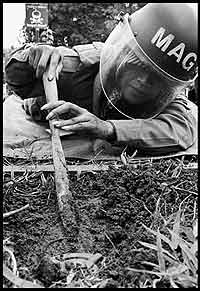
Photo Two: Every time I go into the minefield in the village of Svay Sor I have to put on a special helmet and flak jacket. 8 people have been killed and another 9 injured just in the small area where we’re working – that’s why we’re here. The villagers can’t be sure their land is completely safe until we’ve checked every metre of land.

Photo Three: Each of the metal detectors used by the women in my team are checked regularly. The detectors need to be finely calibrated if they’re to find every single unexploded mine or bomb. We work to strict operating procedures – although the job isn’t without danger, if the deminers follow the rules they should be safe.

Photo 4: As well as clearing minefields, we educate the villagers living in the surrounding areas about the dangers of landmines and unexploded bombs. We explain to them how to minimise the risks. Here in Cambodia landmines are everywhere – the country is one of the most heavily mined in the world. Less than a fortnight ago 3 people travelling through a field in an ox cart rode over an anti-tank mine. They were all killed instantly. It’s that kind of accident we’re trying to avoid.

Photo Five: This woman is pointing at a bomb similar to the one she found in a well in her field. Her nephew removed it, but by doing so he could easily have set it off. Many people living in Svay Sor know the land they live and work on is heavily mined but they have no choice but to work the fields. It’s the only land they have.

Photo 6: It’s important that the deminers maintain the highest standards and clearly every single scrap of metal. To ensure they are, I regularly double-check the work done by the deminers. It’s vital the land cleared is 100% safe – if even a tiny mistake is made, the results could be fatal.

Photo Seven: I plot the day’s progress on a large map. The green shaded areas represent the parts of the minefield that have been cleared. The areas in white still have to be tackled. We’ve only been working in the Svay Sor minefield for two weeks so there’s still a lot of ground to cover. We expect to be here for a while yet – we’ll stay until the job is done.
The amputee deminers story has been posted up on the BBC News Online website. You can find it here.
The ancient Cambodian passport gods have bestowed their blessings upon me and my lost passport -- complete with the crucial visa to get out of the country -- is back in my possession.

The story is a fine example of the power of the internet. The cleaner in a cafe I visited last weekend picked up the passport -- it must have fallen out of my back pocket while my rear end was exploding like a landmine.

She gave it to the western owner of the restaurant....who wasn't sure how to contact me to give it back. He put my name into Google, found the blog, matched the picture on the passport to the pictures on the site and BINGO!! -- he was able to e-mail me and let me know it was safe.

After he didn't hear from me for a couple of days (because I was up near the Thai border and out of internet contact) he took the passport to the British Embassy.

One call to the Ambo's Duty Officer later and the passport was waiting for me at the guardhouse of the Embassy.

The result -- I can spend next week sightseeing and heading off to Angkor Wat instead of waiting for hours at immigration offices trying to find a way out of the country.

A $10 reward has been despatched to the finder and a bottle of cognac is on its way to the owner of the cafe.

The MAG guys here say they know plenty of people who have lost their passports around Phnom Penh but they've never EVER been found again.

I'm a very lucky boy.

Saturday, November 15, 2003

BREAKING NEWS....It seems as if my passport has been found -- in the toilets of a cafe in Phnom Penh of all places. I kid you not. It looks like someone in high places is smiling at me. More soon.
Another audioblog -- a package I did for the World Tonight and Newshour programmes....it's five and a half minutes long.
World Tonight/Newshour Package -- MP3
Wrote an audio essay for the Today Programme...it'll be broadcast on Saturday Morning.

Here's the Essay as an MP3 and, for those unable to download it, here's the transcript:

Almost every aspect of the journey was identical…the same model of four wheel drive… the same rutted mud roads….I was even sitting in the same seat in the vehicle – in the back, to the right of the driver.

Heading towards a minefield………again.

The crucial difference was that at least this time around I had a good idea of where the mines were.

The last time I made this kind of journey, I was heading towards an abandoned defensive position on the outskirts of the Northern Iraqi town of Kifri with the BBC’s Tehran correspondent Jim Muir and cameraman Kaveh Golestan. Saddam Hussein’s regime was in its death throes and, sensing defeat, the soldiers manning the position had deserted their posts a few days earlier. But although the troops had fled they’d left a deadly reminder of their presence behind – a dense ring of anti-personnel landmines.

As I stepped out of our vehicle, I detonated one of the mines with my right heel. Kaveh, instinctively thinking we were coming under mortar fire, tried to run for cover. Instead, he headed deeper into the minefield and was killed instantly by two mines laid a few centimetres apart.

Doctors in Iraq, Cyprus and Britain tried in vain to save my foot and lower leg – and I watched Saddam’s statue come down in Baghdad on television from a hospital bed, recovering from a below knee amputation.

This time around, the minefield was in the village of Auchamlong, a speck on the map in a remote part of northwestern Cambodia, a few miles from the border with Thailand. The area was the scene of some of the fiercest fighting between Pol Pot’s Khmer Rouge and government forces. The use of landmines was commonplace during the fighting over this strategically important spot between the mid 1970s and the early 1990s. Hundreds of people were killed by them over the years – their bones are still found regularly in the forests.

I travelled to Auchamlong with a 15 strong Cambodian demining team paid for by the mine clearance charity, MAG. I was asked to become a patron of the organisation after I lost my leg – and I found my involvement surprisingly therapeutic during six long months of rehab after my accident.

Even though the area where we parked had been cleared of mines a few weeks earlier, I felt an unsettling sense of deja vu as I stepped out of the vehicle.

The feeling of foreboding grew steadily as I was guided deeper into the minefield, dressed in a flak jacket and safety helmet. Moments before I arrived, one of the deminers had uncovered a type of mine known as a PMN, buried just below the soil. It was a PMN that caused the loss of my limb – and now I was standing no more than a metre from an unexploded one.

At the end of their shift, the demolition experts on the team placed 80 grammes of TNT next to the mine and – with the press of a button – blew it to pieces. For me, it was a deeply satisfying moment.

The inherent dangers of the job have forged a strong bond of friendship between the members of the demining team. That friendship’s particularly strong between the five deminers who are themselves victims of the very weapons they now spend their days clearing.

Their nerves are stronger than mine.

During a meal break, I sat down with them on a log under a bamboo tree. We pulled off our artificial legs as others might kick off their shoes in front of the television. Inevitably, we compared one another’s artificial legs. Theirs, they explained, are specially made by the Red Cross. All the metal components have been taken out so as not to interfere with their sensitive mine detecting equipment.

Weighing my modern carbon fibre prosthesis in his hands, one of the deminers asked me how much it would cost. Somewhat embarrassed I admitted it was worth about five thousand pounds – more than three years’ wages – even for a well-paid Cambodian deminer.

My new friend laughed uncontrollably.

If I had that much money, he said, I’d buy myself a big herd of cows. I certainly wouldn’t waste it on a new leg.

What to buy? An artificial limb or a herd of cows. It’s a tough call.


What a week!

Churning out stories like a sausage factory from the Cambodian/Thai border. You can pick one of them up here on the BBC website, although I transcribed it onto the blog on Tuesday.

Here's the latest story -- again a sneaky peek of what'll be on News Online over the weekend:


Dateline: Auchamlong Village, Northwest Cambodia.

For decades, the earth beneath Leng Chantry’s feet was one of the most fiercely fought patches of ground in Cambodia. Auchamlong’s position alongside the Thai border, made it a valuable strategic prize during the country’s bloody past.

Until recently, Auchamlong and the surrounding area was a Khmer Rouge stronghold, off limits to most Cambodians, let alone foreigners.

It was while fighting against Pol Pot’s infamous army in the area in 1985 that Leng Chantry’s leg was blown off by a landmine.

Seriously injured and unable to fight, Leng Chantry struggled desperately just to survive.

“Life after the accident was incredibly difficult,” he told me.

“I was a single man and I didn’t have a wife and family to look after me or a family to support me. All my relatives had been killed by the Khmer Rouge.

“I stayed with a family and worked in their fields in exchange for board and lodge.

“I was living hand to mouth and I felt completely hopeless because I was so poor.”

Facing widespeard prejudice because of his disability, and with little hope of steady employment, Leng Chantry’s future looked bleak.

He trained as a motorcycle mechanic but could not a permanent job.

But in 1996 he was offered the chance to train as a deminer, clearing the very same weapons that nearly cost him his life.

Fitted with a special prosthetic leg, made completely from plastic so as not to interfere with his sensitive metal detecting equipment, Leng Chantry works with a team of 14 other deminers. They carefully probe the soil, looking for hidden ordnance.

He is especially close to 4 of his colleagues who are fellow amputees. During meal breaks they sit alongside each other on a tree trunk, pulling off their artificial legs to rest in the same way that most people would kick off their shoes.

Leng Chantry and his team find a wide variety of different types of landmines every day – from crude improvised explosives to sophisticated Russian and Chinese-made devices.

Each, though, is dealt with in the same way. A block of TNT is placed alongside the mine, attached to a detonator. From a safe distance, a disposal expert presses a button, triggering an explosion which blasts the mine to pieces.

With a monthly salary of $180 dollars a month, the deminers earn almost ten times the Cambodian national average. For Leng Chantry the money has lifted him up the social ladder and enabled him to pay for a long-planned wedding.

As for confronting the weapons that blew off his foot on a daily basis, Leng says he has no fears.

“I don’t get scared because I’m fully trained,” he says.

“There are special operating procedures for working in minefields and if you follow them correctly the job’s actually not so dangerous.

“Anyway, I’m just happy to be able to clear the mines so that people can return to their land in safety.

“Hopefully fewer people will be injured because of my work and won’t have to go through what I have.”

Photo: Leng Chantry And Team
Photo: Amputee Deminer
Photo: Amputee Demining Team

All photos are copyright Sean Sutton/MAG and must not be reproduced without permission.

Tuesday, November 11, 2003

A great photo from Sean taken at the Water Festival.

I'm delighted to be able to upload this stuff from an internet cafe in Battembang -- home of the most ropey internet connection in Asia!
An extremely busy couple of days in Phnom Penh, not helped by the fact that I had my passport stolen while recording some stuff at the water festival on the weekend.

All manner of bureaucratic problems await me before I get out of Cambodia, but I'm pressing ahead with the assignment and am now in Battembang, a four hour drive from the capital.

I'm heading out into the wilds near the Thai border shortly, so this is just a quick update before I disappear for a couple of days.

I've written my first piece for BBC News Online...here's a sneaky peak and a couple of pictures taken by Sean Sutton from MAG, who I'm travelling with.

I'll probably be back from the sticks on Thursday. More then.


Chum Sakhorn has no doubts about who was to blame for robbing him of both of his legs.

On one of his two artificial limbs, Sakhorn – a 38 year old father of 7 – has written the words “I was cheated by war” in blue marker pen.

In 1987, Chum Sakhorn was fighting the infamous Khmer Rouge in one of its strongholds near the border between Cambodia and Thailand when he stepped on a landmine.

“I was fighting in Phnom Malay,” he told me.

“I was transporting equipment for my regiment. I wanted to cross a bridge – but it had been blown up by a big anti-tank mine.

“I couldn’t go across, so I took a detour. I spotted one mine and disarmed it but while I was walking along a small path I stepped on another one.”

The resulting explosion blew off both of Chum Sakhorn’s legs below the knees.

He is now among Cambodia’s estimated 40,000 chon pika – or amputees. With a population of around 11.5 million, Cambodia has one amputee for every 290 people – one of the highest ratios in the world.

But Chum Sakhorn says the landmine he stepped on also blew away any chance he had of a successful future.

16 years on from his accident, he ekes out a living selling books and postcards to tourists in Phnom Penh’s central market with a group of other mine-injured former soldiers. A local bookseller lends them the merchandise and pays them a small commission on each item sold.

Most retailers in the market, though, are less sympathetic. They regard the amputees as the lowest of the low.

“Life for amputees in Cambodia is very bad,” Sakhorn says.

“The shopkeepers don’t even like me standing in front of their stores.

“Sometimes the police try to arrest us, or confiscate our merchandise. We’re treated like outcasts – the authorities harrass us because they think we’re below them.”

Outside the main cities, 85% of Cambodians rely on agriculture for their livelihoods. Cambodia’s chronic mine contamination problem means the threat of death or serious injury is a daily reality for most people here.


“A recent survey found that more than 40% of the villages in Cambodia have a mine problem,” says Sean Sutton from the Mines Advisory Group (MAG), an international mine clearance charity.

“Cambodia was constantly at war from more than 20 years. Landmines were widely used by all sides.

“Each time an area changed hands fresh mines were laid in areas that were already heavily contamined.”

Indeed, Pol Pot – the head of the genocidal Khmer Rouge regime responsible for the deaths of millions of Cambodians during the 1970s – described landmines as his “perfect soldiers,” so effective were they at causing fear and death.

Democratic elections in 1993 heralded the start of a period of relative calm in Cambodia and many displaced people began returning home from refugee camps in Thailand.

Yet this population movement brought another wave of landmine casualties.

“Many villagers lost limbs trying to reclaim the land they’d been forced from years before,” explains Sean Sutton.

“Many of them knew their villages and fields were mined but they needed to work the land in order to survive.

“They knew they were risking their lives – but they had no choice.”

Picture: Chum Sakhorn at work
Picture: Amputees ekeing out a living -- Phnom Penh Central Market
Picture: Comparing Legs

Sunday, November 09, 2003

I notice from the traffic stats that dozens, nay hundreds, of people are coming to the site trying to find the gory details of the (strenuously denied of course) allegations about Prince Charles.

Sorry to disappoint, but an injunction is an injunction.


I’ve finally discovered the ultimate long haul flight survival cocktail.

It consists of 2 double brandys, 2 glasses of Merlot, 3 Singha beers and 10mg of valium. It made 11 hours in economy class on the London to Bangkok flight zip by in a dreamy fug.

Arriving at Bangkok Airport it didn’t take long to get a taste of the hospitality for which Thailand is famous. I stopped off at a booth to get some photos for my Cambodian visa. Handing over $5 for the snaps, the assistant asked – completely unprompted -- “You wan’ girl?” Thanks for the thought, but just the four passport photos will be fine.

One short connecting flight later and I thrown immediately into the humid soup of Phnom Penh with its chaotic swarm of motos -- men, women and children hanging precariously off the back.

Our hotel – the Goldiana – may be cheap at $35 a night but the regulations are strict. The front page of the guide left in the room insists that “All kinds of explosive devices are not allowed to be brought into the hotel,” and “prostitutes are not allowed.”

Guess we’ll be looking for new digs tomorrow.

After a couple of hours’ sleep we picked up a moto and headed out to the Foreign Correspondents Club, a fine and welcoming watering hole andd a genuine Phnom Penh institution. As well as smattering of tourists, the clientele was mostly made up of aid workers and journalists enjoying a spot of R & R. We’ve purposely timed our arrival in Phnom Penh to coincide with the festival of Bon Om Tuk – one of the most important celebrations in the Khmer calendar.

The festival marks the reversal of the current of the Tonie Sap river. It’s caused by the onset of the dry season, when the water backed up in the Tonie Sap lake begins to drain into the Mekong.

From our vantage point on the balcony of the FCC we were able to watch the boat races held as part of Bon Om Tuk and cheer on the crews of 30 or more as they hammered down the river – Phnom Penh’s answer to the Oxford versus Cambridge boat race – and enjoy the fireworks display which marked the close of the day’s racing.

And now...an audiovisual extravaganza:

Audioblog: Cambodian Moto Etiquette....with Sean Sutton. mp3

Picture: 3 on a moto
Picture: Phnom Penh Cyclo
Picture: Filming You....
Picture...Filimg Me
Picture: Shopping For Feet
Picture: Cigar Smoking at the FCC
Picture: Fireworks Over Tonie Sap

Thursday, November 06, 2003

If you're an occasional reader of the blog, be sure to check in over the next fortnight.

If you're a regular -- spread the word.

Tomorrow morning I head off to Cambodia for a two-week assignment with the Mines Advisory Group.

We'll be heading to Battembang in the northwest of the country -- one of the most mined areas of one of the most heavily mined countries in the world.

I'll be staying with villagers who live with landmines literally on their doorsteps. I'll be documenting and recording their stories and reporting on the landmine clearance efforts taking place in Cambodia.

I've got a host of commissions already lined up for a variety of BBC News outlets....Radio 4, 5 Live, World Service, News Online and others....so don't be surprised if you hear me pop up over the next few weeks.

I'm taking plenty of communications equipment with me and I'll try to update the blog as often as connections allow.

In the meantime, you can read more about MAG's work in Cambodia here.
PRINCE CHARLES LIKES GOOD HEADGEAR


Tonight the looming Charliegate scandal reached new levels of ludicrousness.

All day the newsroom has been awash with speculation over the identity of the member of the Royal Family who was allegedly seen involved in "an incident" by a former Royal employee.

Who was the Royal? What was the alleged "incident"?

There were plenty of rumours, as there always are with these kinds of stories.

Tonight, the identity of the member of royal family at the centre of the allegations was confirmed as Prince Charles.

In a farcical performance, the Prince's private secretary Sir Michael Peat went on camera to strenuously deny that an incident which he wasn't able to describe -- and which isn't in the public domain -- ever took place.

Peat also took the opportunity to smear the former royal aide who made the allegation "who, unfortunately, has suffered from post-traumatic stress disorder and has previously suffered from alcoholism following active service in the Falklands."

I fear this rearguard action by Prince Charles's private secretary will backfire....but that's enough innuendos for one night.
Set your video for 2100GMT this Sunday.

BBC One is screening a Panorama special, In the Line of Fire, about the friendly fire incident in which John Simpson and the team with which I worked in Northern Iraq got caught up just a few days after my accident.

If you haven't already seen it, it also features Fred Scott's award-winning footage of the incident.

Apparently I also make a brief appearance.

Here's the publicity poster for the show.
THIS MAN IS AN IDIOT


I often discuss the issue of safety for foreign correspondents but TV Week has an interesting report on how local newshounds in California responded to the recent wildfires.

The reporter pictured above -- KNBC newsman Chuck Henry -- put his and his cameraman's life at risk by broadcasting live while the flames were licking around his heels. When his news truck failed to start -- and then burst into flames -- he relied on a fireman to get him out alive.

Henry's egocentric and ratings-obsessed desire to put himself at the centre of the story defies basic news safety principles. Reporting live while the flames are warming your chestnuts isn't brave or innovative journalism -- it's just plain stupid.

He should have fried.
After the Iraq War the BBC commissioned research from Cardiff University to examine how the embedding system worked.

The findings are being released today at the News Xchange conference in Budapest.

The headline: "The criticisms that were made at the time, that the embedded reporters were more likely to give a pro-war spin, do not hold up.

"But we do have some reservations, particularly about the narrative that is created by embedded reports, where the only discussion is about who's winning and who's losing, with little of the wider picture."


Read more here and here.
Steve Earle is God.

That's just fact -- not least because he's an anti-landmine campaigner.

Earle shares his views on the media here.

Wednesday, November 05, 2003

Alex alerts me to the top notch tale of 81-year old Albert Skipper, who has had his finances taken over by Greenwich Council after he spent £6,500 on prostitutes in a 9 week frenzy of geriatric whoring.

"They are stopping my money because they don't want me to spend it on call girls," says the exhausted octogenarian, who now has to survive on £90 a week pocket money. "What do I want to save money for? I'm 81."

Fair point.

If he was capable of blowing (probably quite literally) more than six grand on ladies of easy virtue in a little over two months, a paltry ninety quid a week isn't going to go very far.

I might give him a hand(job)-out and send him a tenner with my best wishes.
A disturbing development for press freedom in Israel.

Haaretz and Reuters report that the Shin Bet secret security service has carried out checks on thousands of journalists holding government press cards.

Israel is the only democratic country where press cards are issued by a government agency rather than by a journalists' organisation but now, for alleged security reasons, the authorities want to be able to decide who can and cannot work as a journalist in Israel.

The concern must be that some correspondents will have their press cards rescinded not because they are a security risk but rather because the authorities don't like what they're writing.

Reporters Without Borders is among the organisations calling for the new rules to be scrapped.

Tuesday, November 04, 2003

Anyone who's spent any time in Cardiff will be familiar with the Hades-on-Earth that is Caroline Street.

Otherwise known as "Chip Alley", it's a thoroughfare of chippies, kebab shops and pizza places that can diplomatically be described as "lively" after the pubs shut.

It's a genuine slice of Cardiff history, and so I was delighted to receive everyday story of Caroline Street folk involving an assault with a carton of curry. Mind you, six months in the slammer does seem a bit excessive.

Which reminds me of my favourite Cardiff joke....How can you tell when a Cardiff girl has had an orgasm?.....She drops her chips.
A special hello to David Horrocks from MAG, who has put the first pin in the Guest Map from Iraq, where he's involved in the mine clearance effort.

David -- if you want to e-mail me with news of how the work's going there I'd be very keen to post it up here....and your homework for this week is to find out how to say "I have an artificial leg" in Kurdish!

And a reminder that if you haven't put your pin in the guest map you're encouraged to do so without delay.
TAKE ME HOME IN A TRANSFER TUBE
"This White House is the greatest user of propaganda in American history and if they had a shred of honesty, they would admit it. But they can't" -- Christopher Simpson, professor of communications, American University, Washington (Source: Toronto Star)

On the subject of the propaganda war, the Toronto Star article paints a very different picture of conditions at the Walter Reed Army Medical Centre to that depicted in the NBC news report I linked to earlier. The Star claims the crush of casualties in late summer was such that outpatients had to be referred to nearby hotels because the hospital was full.

Thanks for the link, Lynn.
A frustrating visit to the Artificial Limb centre today, where work has begun on making my third prosthesis.

Yesterday my prosthetist, Ian, made a plaster cast which will form the basis of the new limb. Today I returned so that he could check the fit on the new socket. When I put it on, though, it felt too tight -- like wearing a pair of shoes a couple of sizes too small.

The problem, Ian explained, is that I'm "between sizes."

The Iceross silicone liner that I've been using for a while is getting a little bit too big for the much-reduced Mr Stumpy -- so he gave me the next size down to wear when he took the new cast. However, a smaller socket combined with a smaller liner is too much of a tight squeeze at the moment.

It's not too much of a problem. Ian simply took a second cast over the top of the larger liner. It does, however, mean an extra trip to Cardiff when I get back from Cambodia for another diagnostic fitting to ensure everything is as it should be before the leg is finally made.

In the grand scheme of things it's a small inconvenience if the finished product is more comfortable -- and things could be worse...I could have ended up like this bloke.
A BNI Sports Exclusive -- The All Blacks are fielding a player with his left leg amputated below the knee.....and he's so tough that he plays without a prosthesis!

New Zealand's physiotherapists can't be up to much, though -- never mind his cruciate ligament injury. Has no one noticed that half of Tana Umaga's leg is missing? (Thanks for the link, Steve).

Also on the subject of sporting amputees (real ones this time), I came across the story of American footballer Neil Parry -- who, like me, is a below right knee amputee -- while searching for something else....I was actually looking for the video report on NBC's Nightly News a few nights ago about soldiers who have lost limbs fighting in Iraq.

Monday, November 03, 2003

Thanks to everyone who offered suggestions on how to get RSS Autodiscovery to work on Newzcrawler when you access the site through the www.stuhughes.co.uk domain address.

The upshot seems to be that getting it to work is more trouble than it's worth, so if you want to access the Autodiscovery to work, direct your browser to http://stuarthughes.blogspot.com

And now -- to Cardiff, for new leg construction.
It's all very well saying you had dinner at the Walnut Tree, writes one correspondent, but what was on the menu?

Do you really want to know?

Well, I started with roast pigeon (which was superb) followed by grilled swordfish with pesto.

Aileen went for the Thai crab cake to start, followed by ribeye of beef (half of which I ate -- it was beautifully cooked). I think Aileen chose wisely. I was a little disappointed with the swordfish. I only went for it because I never order fish at restaurants. Now I remember why.

We shared a cheese board and I finished off with a selection of home made ice creams. The vanilla was particularly good.

The wine was a 1998 Viognier.....light, crisp and a little too drinkable for its own good.

In fact, rescued from the bin (because I don't want to remind myself how much it cost until the credit card statement arrives) here's the bill.

Bill-blogging...another first from BNI.

Sunday, November 02, 2003

A quick round up of bits of pieces from over the weekend.

BBC News Online reports on Saturday's "shoe pyramid" event against landmines in central London. News Online also has reports from my colleagues Claire Marshall on the landmine situation in Colombia and John Sweeney on the killing of cameraman James Miller and other internationals by the Israeli Army. The Justice 4 James Miller website also has a wealth of resources connected to the case -- it's a first class site.

Fergal Keane writes in the Independent on Sunday on the cameramen celebrated at the Rory Peck Awards but his column is subscription only. If anyone has a subscription and is able to cut and paste me the article -- or send me a scan of the printed version -- I'd be very keen to read it.


Back from a wonderful weekend in the Welsh Borders to celebrate Ails's birthday.

We stayed at the Allt Yr Ynys Hotel near Abergavenny and made good on a promise we made a long time ago to have dinner at the Waltnut Tree restaurant -- expensive but worth it!

The Black Mountains is one of my favourite parts of the world -- the scenery's just breathtaking -- so we made sure we made the most of it by following up a morning's clay pigeon shooting with a walk up Skirrid Fawr.

It was the first time I'd climbed a hill with my artificial leg and it was definitely the stiffest test so far for the Flex Foot. I'm pleased to say it passed with flying colours....bring on Everest!

This morning we took a couple of ponies from Trevelog Farm for a ride through the Llanthony Valley. The Autumn colours were just incredible -- and the horses made easier work of the hills than I did!

Picture: Shooting 1
Picture: Shooting 2
Picture: Shooting 3
Picture: Shooting 4
Picture: Climbing Skirrid 1
Picture: Climbing Skirrid 2

Friday, October 31, 2003

I'm off to deepest, darkest Herefordshire for the weekend to celebrate Aileen's birthday, so blogging will be sporadic for the next couple of days.

Normal service will resume on Sunday -- forthcoming attractions include a trip to Cardiff next week for leg casting number 3 and then, of course, Landmine Blogging from Cambodia.

Some things to watch out for over the next couple of days:

The charity Handicap International is holding a Stamp Out Landmines event in Trafalgar Square tomorrow to mark the start of Landmine Action Week.

The "My Favourite Hymns" programme on ITV1 at 1145GMT on Sunday features the recent memorial service at St Brides for the journalists killed in the Iraq war.

The documentary "When Killing Is Easy" on BBC2 at 1910GMT on Sunday examines the killing of journalist James Miller by the Israeli army in Rafah.
The Amputee's Phrasebook just keeps on growing.

The latest addition -- Georgian: me maqvs khis phekhi (Thanks, Kevin).
Inspired by my comments earlier in the week about California fire-blogging, BNI Guest Writer Alex Lemon takes up the subject in a piece for the latest edition of cult e-zine The Friday Thing.
It's available by subscription only -- so in a clear breach of copyright here it is as a Word or Plain Text document.
Alex Lemon -- Scorchio (.doc)
Alex Lemon -- Scorchio (.txt)
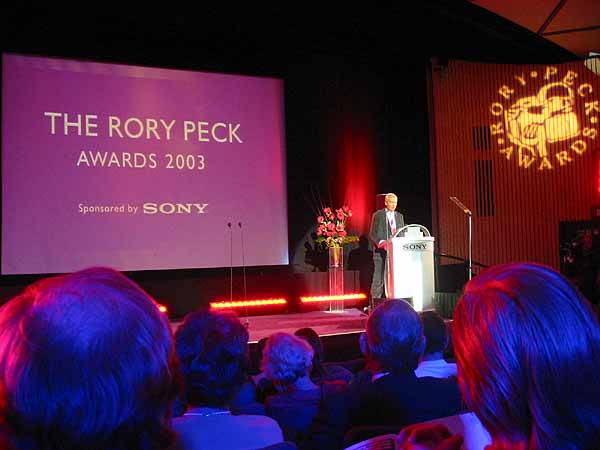
A great (and suitably drunken) night at the Rory Peck Awards, which showcased some stunning examples of the cameraman's art.

The winners were:
Hard News Award: Frederick Scott, Northern Iraq Friendly Fire Incident
Rory Peck Award for Features: Rodrigo Vazquez, The Killing Zone (Gaza)
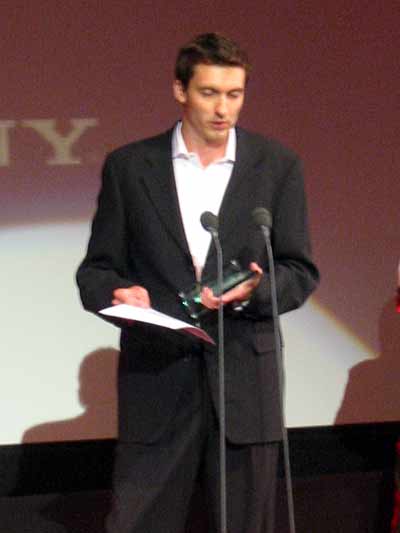
Sony International Impact Award: James Brabazon, A Journey Without Maps (Liberia & Guinea)

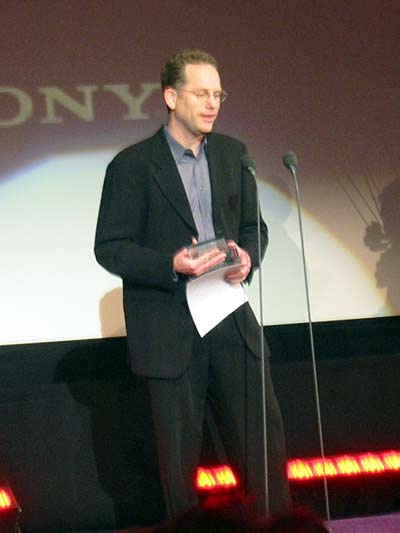
Special congratulations, of course, to Fred -- whose report from Northern Iraq I watched from my hospital bed the day before my amputation.

You can read more about the winners here and watch a webcast of the ceremony here. The Media Guardian reports on the winners here.

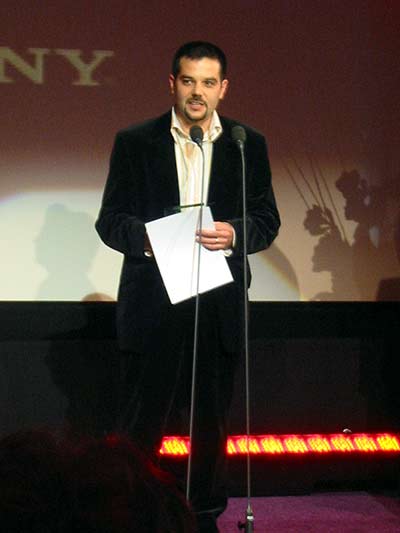
Picture: Rory Peck Awards 2003
Picture: Fred collects his award
Picture: Fred's acceptance speech
Picture: James Brabazon
Picture: Rodrigo Vazquez

Thursday, October 30, 2003

Off to the National Film Theatre shortly for the Rory Peck Awards ceremony.

I'll probably be too drunk to do it tonight but I'll upload photos etc tomorrow.
Some more useful phrases for amputees on the move, courtesy of the BBC's fixer in Riga:

Man ir maksliga kaja -- Latvian
Mul on tehisjalg -- Estonian
Mulla on keinotekoinen jalka -- Finnish

I can now look forward to travelling around the Baltic States with ease.
Check and double check your facts before committing your story to paper, I was always told as a trainee journalist.

It's a lesson that obviously hasn't been learnt by scribes on the Daily Mirror. The paper today led with a story that is set to become one of the all-time journalism cock ups (literally.)

"It's a Boy" declares today's front page, "Exclusive - Macca baby a month early!"

"I think they are going to call the baby Joseph after Paul's uncle," a source close to the McCartney family was quoted as saying.

A great scoop for the Mirror....except...er....it's not a boy. It's a girl.

Biology lesson for all Mirror hacks...Boy babies have willies. Girl babies do not.

Unless the McCartneys' new arrival is a hermaphrodite.

Wednesday, October 29, 2003

A geeky question which hopefully someone out there will be able to help me with...

I've added RSS autodiscovery tags to the Blogger template but the Autodiscovery option only seems to come up on NewzCrawler when you access the site through the URL http://stuarthughes.blogspot.com and not through www.stuhughes.co.uk.

Any idea why -- and what I can do about it?
The Associated Press wire is running an interesting story on the use of private contractors by the US military in conflict zones around the world.

Outsourcing frees up troops to fight -- but also reduces the numbers on official body counts.

"It's a massive business boom for the private security field," one contractor says.

Ker-ching!
And so farewell to the Quiet Man.

For the fourth time in 13 years the Conservative Party has demonstrated its seemingly boundless capacity to stab itself in the back.

The campaign to oust Iain Duncan-Smith seems rather like shouting at the the driver of a Robin Reliant for not driving fast enough -- the problem is with what's underneath the bonnet, not who's behind the wheel.

You can relive those moments of Tory self-destruction in all their suicidal glory through the superb BBC News Online archives here and here.


It's sad but inevitable that the Red Cross has decided to reduce its foreign staff in Iraq.

The attack on the ICRC HQ in Baghdad left the organisation with little choice but to reassess its operations -- and is the most telling sign yet of how unstable the situation in Iraq is.
Jo has been hard at work finding new additions for the European Amputee Phrasebook.

She's come up with the following:

Welsh: Mae coes artiffisial da fi
Russian: 'oo men-YA noh-GA proh-TEZ' (Phonetic)

Keep 'em coming.

Tuesday, October 28, 2003

This has already appeared on Boing Boing, so it's probably all over the place by now but it's still worth mentioning as an example of the increasingly blurred boundaries between blogging and journalism.

People affected by the wildfires in southern California are being encouraged to e-mail their eyewitness photos -- taken with camera phones and digital cameras -- to this hastily constructed website.

It's the future of journalism in action -- instant reportage gathered not by media "professionals" but by ordinary punters who find themselves at the centre of the story.
I thought next week's assignment to Cambodia would take me to the undiscovered heart of south-east Asia.

But it seems every Hollywood starlet and do-gooding popstar in Celebrityville is beating a path to Phnom Penh. The London Evening Standard reports that Minnie Driver is the latest celeb to head to the former Killing Fields. She's apparently giving up her showbiz lifestyle to work in a Cambodian clothing sweatshop. Maybe she can run me up a couple of pairs of slacks while she's there.

It can't be long before showbiz party-goers are overheard lamenting the fact that Cambodia is soooooo last season.
Paul Krugman's writings never fail to cause a stir in the blogosphere and today's offering in the NY Times is no exception.

Krugman's central argument -- "we'll lose the fight against terror if we don't make an effort to understand how others think" -- is hardly revelatory but it needed to said.


Charlie Glass e-mails to highlight an auction of photographs by some of the world's leading photojournalists which will be held at Bridewell Hall, Fleet Street on 6.45pm on Thursday November 13.

The auction will raise money for the Indochina Media Memorial Foundation, which was established in 1991 to mark the lives and deaths of more than 300 journalists from two dozen nations who died covering all sides of the Indochina conflict from 1945 - 1975.

The proceeds will support a workshop in Vietnam in 2004.
In May 1960 an American DJ, Alan Freed, was indicted for accepting $2,500 from record companies in return for airplay.

The practice -- known as payola -- was outlawed after Freed's trial and became punishable by up to a year in prison and fines of up to $10,000.

According to a piece in the New York Times payola is alive and well on the "news" programmes broadcast on American Airlines flights.

Actually, as a former radio talk show producer myself, why didn't I think of charging guests to come on the air?

Monday, October 27, 2003

Caught up today with a work colleague I hadn't seen in quite a while.

She said she'd taken a particular interest in what happened to me because her husband had a serious accident a few months ago and is now temporarily in a wheelchair.

She remarked on a radio interview I had done in which I spoke about the difficulties in suddenly going from being on two feet to being in a wheelchair.

My colleague's husband accidently slipped off a balcony and broke the heelbones in both feet. What made things harder was that they'd just had their first baby. He's self-employed and so doesn't enjoy the same company benefits that I did -- and yet the doctors say it might be 18 months before he's able to work.

It got me thinking hard about what happened to me.

Stepping on a landmine wasn't the cleverest thing I've ever done, for sure, but at least once the amputation was over I was able to start the rehab fairly quickly...and six months down the line I'm in good shape.

The future for my friend's hubby is still uncertain.

I was again struck by that unsettling sense of how life can change irrevocably in an instant. An explosion, a fall, a car crash, a stroke -- and things will never be the same again.
During last week's talk to BBC bloggers I met a radio producer from BBC Scotland called Margaret Telfer. I've belatedly dicovered she's got her own blog -- Little Blip.

Margaret's been good enough to give me a mention -- so I'm happy to return the favour.

...and that's a very funky portrait you've got there, Margaret!
I've mentioned this award before but I missed the BBC News story last week because I was in Spain:
BBC News: Award set up to honour BBC cameraman
The winners of this year's Rory Peck Awards, which I helped judge, will be announced on Thursday.

Channel 4 and others will be showing extracts this week at the following times:

October 27- 30 Channel 4 TV The Rory Peck Awards Slot 19.55 GMT
November 1 BBC World In The Firing Line 13.10 GMT
" " BBC World In The Firing Line 22.10 GMT
" " BBC News 24 In The Firing Line 15.30 GMT
November 2 BBC World In The Firing Line 09.10 GMT
" " BBC News 24 In The Firing Line 02.30 GMT
" " BBC World In The Firing Line 18.10 GMT
" " BBC News 24 In The Firing Line 21.30 GMT
November 5 MTV3 (Finland) 45min 18.00 GMT+2

You can also read more about the finalists here.

Saturday, October 25, 2003

An audioblog from Madrid -- an interview I did with the Iraqi Trade Minister, Dr Ali Allawi.

It's 3mins 32secs long and is a 623Kb download:
Ali Allawi Interview (MP3)

Friday, October 24, 2003

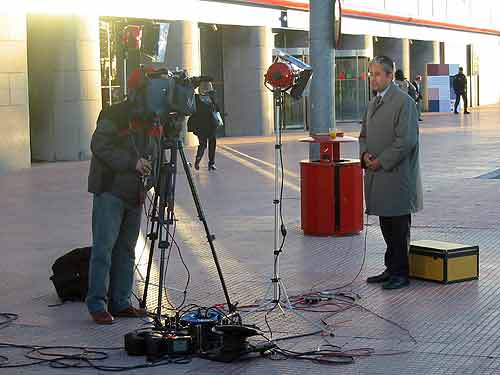
As is always the way with these kind of summits, the temporary world of press cubicles, workspaces and TV live positions disappear as quickly as they´d appeared.

As soon as the closing press conference is over, with the warm words and final statements still ringing around the conference hall, an army of technicians appears to begin dismantling and derigging.

What was just a few hours earlier the location for the world´s leading new story quickly becomes a building site of planks, cables and lighting towers.

And we the hacks pack up our pencils and head home.
Urgent note to all international donors....in addition to the billions of dollars please send some decent suits for members of the Iraqi Governing Council.
This whole event is getting more and more like a charity Telethon.

Each country has ten minutes of podium time in which to say how much they're going to donate to the Iraq reconstruction effort. They could put their cheques in an envelope, write "James Wolfensohn, President, World Bank, Washington DC" on the front, and stick them in the post. It'd be a lot quicker.

But no.

Each donor country wants its 10 minutes in the spotlight to say how important it is to pomote peace and prosperity in Iraq. As there are dozens of donor countries the speeches will take all day. Each one is greeted by a polite round of applause as the countries reveal the size of their wonga.....Saudi Arabia -- $1bn (clap, clap, clap)...Japan -- $3.5bn (clap, clap, clap). And so it goes on.

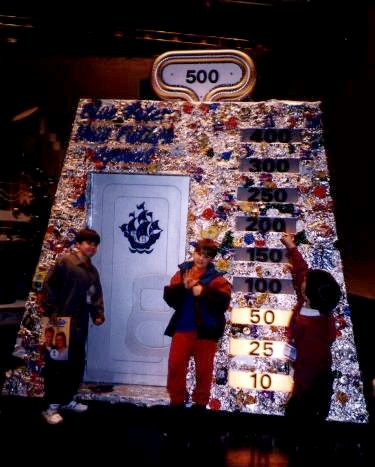
All the conference is missing is a Blue Peter style totaliser, on which to to flash the donations as they roll in.

A few more pictures:
Katya talks to the World Service
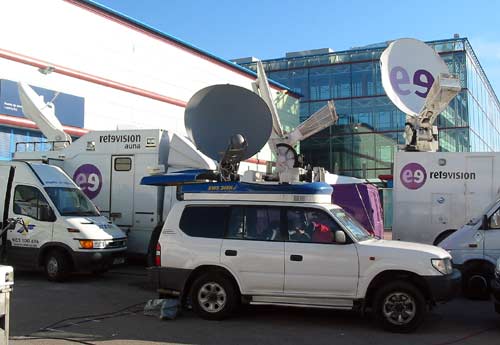
Satellite City
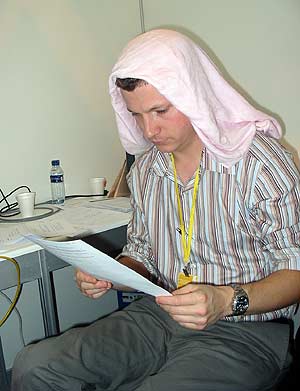
Getting into the part for my voiceover as a Saudi Sheikh
Courtesy of Claire, some more additions to the European Phrasebook for Amputees.

German: "Ich habe ein künstliches Bein"
Dutch: "Ik heb een kunstbeen"
Serbian: "Vestacka noga"

Keep 'em coming.
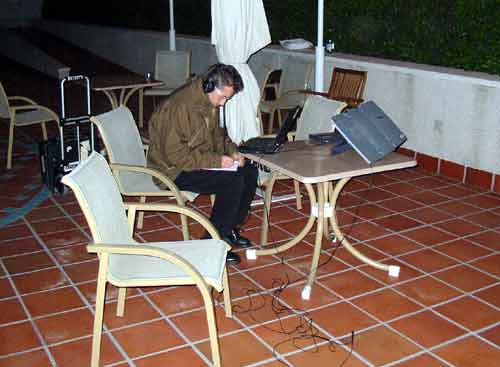
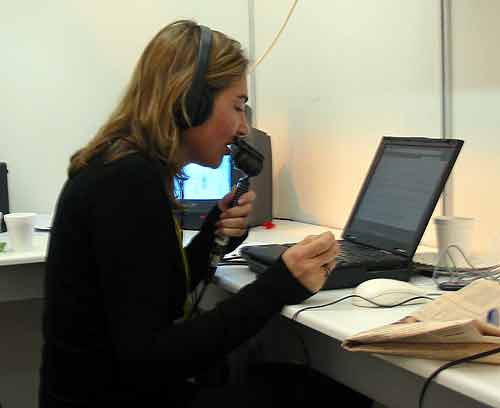
A quieter morning, thankfully, with no Spanish police officers to spoil matters. I found a perfect spot from which to broadcast from the hotel sundeck, right next to the swimming pool. The water didn't look too inviting at 7 o'clock this morning but there was a clear view of the satellite and that's all I care about.

Yesterday we squeezed this story like a sponge...and today we've got to do it all over again. Today is Show Me the Money Day -- when all the donor countries put their cheques on the table and say how much they'll donate towards the reconstruction of Iraq.

As is often the way in this age of rolling news we preview the story to death before it actually happens -- so that by the time the announcements are officially made everyone's bored to death with it.

Some more snaps:
Jamie Goes Live
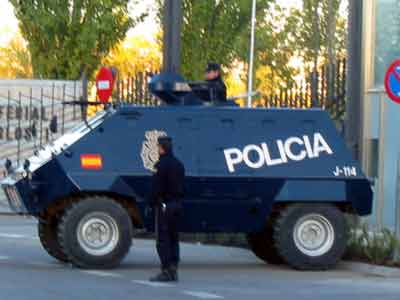
Tight Security
Home Sweet Home

Thursday, October 23, 2003

As is often the case with these kind of events, there's a hugely surreal air about the proceedings here in Madrid.

We're reporting on what's needed to rebuild Iraq's schools, hospitals, transport system, electricity infrastructure.

The figures involved are mind-boggling; the US says $55 billion is required over the next five years to rebuild Iraq and UN Secretary General Kofi Annan is urging delegates to "give generously." The whole conference is the world's biggest exercise in tin-rattling.

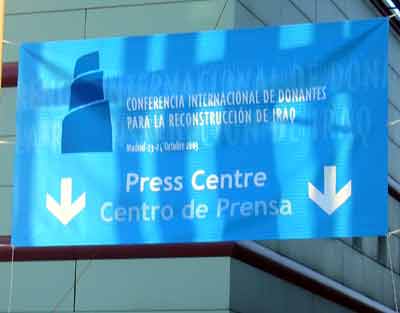
Yet we report on these decisions and pledges that will shape the future of Iraq from inside a cavernous press centre. We watch the proceedings on TV screens which pipe the pictures from the conference floor several hundred metres away.

Even if we had the time to go and talk to the delegates making these monumental decisions we couldn't; there's a security cordon around the main conference venue -- and the press aren't allowed in. We're forced to rely for our information on those delegates who can be persuaded to walk over to the press centre.

Iraq seems a million miles away.
It'll probably get me disqualified, but here goes...

Shirin e-mails to say that the Guardian is currently looking out for candidates for the British Blog Awards 2003.

I've already put an entry in but if you feel the urge to lobby on my behalf, why not e-mail them at weblog@guardianunlimited.co.uk and tell 'em who you'd like to see among the winners!
Another addition to my forthcoming book; The European Phrasebook for Amputees.

The Spanish for "I have an artificial leg"......"Tengo una pierna artificial."

The security guards at the press centre seemed to like it -- it got them grinning like Cheshire cats.
The reason we´re here:
BBC News: Annan tells Iraq donors to dig deep

And a few quick snaps from around the press centre:
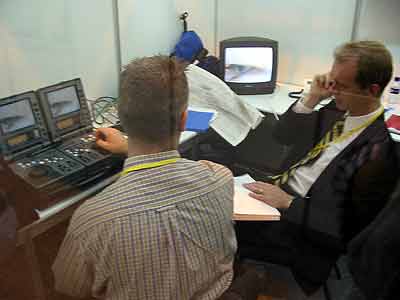
TV Edit Suite
Iraqi Press Conference
The Future of Iraq
Quil At Work
Mixing Desk
An early brush with the long arm of the Spanish law.

As the press centre didn't open until 8am we were forced to improvise for our early morning radio interviews for the Today programme and 5 Live Breakfast. Normally this is straightforward enough -- simply a case of sticking the satellite dish out of the hotel window and broadcasting from the comfort of the room.

The hotel we're staying at here in Madrid, however, faces an office block which blocks the satellite signal.

So, at half past six this morning, I found myself setting up the dish atop a rubbish bin around the corner from the hotel, where the sightline of the satellite was better (who said foreign news was glamorous.)

All seemed to be going swimmingly -- the satellite signal was nice and strong, the ISDN line connected with no problem, we were ready to broadcast.

Until....

Seconds before Chris Morris was about to go on air on 5 Live two vanloads of Spanish police screeched to a halt at the roadside. As soon as they saw out broadcasting equipment, lights flashing, dish aloft, they freaked.

"Pasaporte, pasaporte," they hissed, obviously convinced that they'd stumbled across a terrorist command centre operating from a dustbin in downtown Madrid.

We showed our passports, trying to remain as tranquilo as possible even though we'd just been knocked off air by the Keystone Cops.

After a light roughing up and a long squint at our papers they seemed satisfied that we didn't represent an imminent threat to national security.

Wednesday, October 22, 2003

My flight to Madrid was spoilt by the fact that Britain's fattest man was sitting in the seat next to me.

He must have been knocking on 30 stone...the seat belt barely got past his hips, let alone encircling his mountainous gut. The cabin crew had to give him a belt extension to keep him strapped down for takeoff.

Mr Lardarse fell asleep as soon as he took his seat. His porky arms spilled over the sides of his chair and threatened to encroach mine. His fat legs blocked the gangway, meaning I couldn't step over him to get to the loo mid-flight.

It got be thinking again about notions of able-bodied Vs disabled. If the plane had crashed I know for a fact which of us would have won the race for the emergency exit -- and it wouldn't have been Fatboy Slim.
A couple of newsbites from the airport before I go.

The Media Guardian reports on comments by my boss -- BBC Head of Newsgathering Adrian Van Klaveren -- at the Newsworld conference in Dublin.
Also at Newsworld, journalism legend Walter Cronkite deserved to be immediately stripped of his lifetime achievement award for arguing that he believes in censorship during wartime.

Cronkite obviously believes in freedom of the press when it suits him.
Off to Madrid this morning for the Iraq Donors Conference.

Already it looks like the conference will fall short of raising the $36 billion needed to get Iraq's economy up and running again. Also, a diplomatic asymmetry is emerging -- with the US sending a high-powered delegation headed up by Colin Powell but many other countries sending relatively minor officials.

More when I get there....

AP: U.S. seeks billions to rebuild Iraq or at least signs of support at Spain donor conference
Reuters: Iraq Fund-Raising Effort Faces Political Hurdles

Tuesday, October 21, 2003

It's the return of the audioblog.

Last night I gave a talk to a group of BBC colleagues who are also bloggers about my experience of warblogging and, following my accident, gimpblogging (Hey -- have I just invented a whole new genre...the gimpblog?)

Here's an 3 minute MP3 audio extract from my talk. The file is just over 380Kb. As always I've kept the bit rate down to reduce the file size -- if you'd like to hear it in better quality, just let me know.

A roll of some of the bloggers in attendance last night:
The Obvious?
Paranoid Fish
Digital Dust
Take One Onion
Older and Growing
Plastic Bag
Synesthesia
Curry Bet
Michael Howard reports on the "tourist boom" in Iraqi Kurdistan.

Where will you be taking your holidays next summer? The Caribbean? The Maldives? A villa in Tuscany, perhaps?

Me -- I'll be enjoying a fortnight in Sulaymaniyah. I'll pop into Thomas Cook tomorrow morning and ask for 14 nights in the Suly Palace.

Actually, the article explores important issues concerning the difficulty of reconnecting Kurdish Northern Iraq, which has been autonomous for a decade, with the rest of the post-Saddam country.
"Comedian" Jim Davidson has always been about as funny as a case of the clap.

Yesterday, however, Davidson showed what a truly odious creature he really is.

He pulled out of a performance in Plymouth because he took exception to wheelchair users in the front row.

A spokesman for the theatre involved said that "Mr Davidson cited the fact that a proportion of his act was aimed at disabled customers and that he would be unable to perform under these circumstances."

I have little time for political correctness but I find Davidson's request that the wheelchair users move utterly breathtaking. What if the "offending" patrons had been black, blind, Chinese or women?

Davidson's next shows in Swansea will go ahead. Would the Swansea Grand Pavilion host a National Front rally? I suspect not, but Davidson's attitude towards disabled people is as sickening as the NF's towards ethnic minorities.

I encourage you to e-mail Jim Davidson's tour promoters at sasha@midasmediagroup.com to express your views on the Master of Mirth.
I've written about Alex Zanardi, the former Grand Prix driver who lost both his legs in a crash, before.

According to this story (thanks Steve) he's doing pretty well in his modified car.

There's hope for me and my Ford Focus yet.
Nice to see the Great British Public appreciated the news coverage that I gave my right foot to provide:
BBC News: TV 'overdosed on war coverage'

Monday, October 20, 2003

The Middle East road map may be leading nowhere as the suicide bombings continue and the "Security Fence" cuts deep into the West Bank but fear not. There's a new force for peace in the troubled region -- and it's bright red and furry (thanks for the link Alex):
Ananova: EU backs Sesame Street plan to aid peace
To Princess Diana's other virtues -- such as an ability to heal the sick, make the lame walk, and turn water into wine -- we can now add the power of prophecy.

Once again the stinking corpse of the Queen of Hearts is dug up -- this time by the Daily Mirror.

Former Diana groupie Paul Burrell reveals that the princess wrote him a letter ten months before her death in which she claimed there was a plot to kill her in a car crash.

Burrell could have taken the ramblings of his paranoid and unhinged paymistress to the proper authorities years ago. But instead he has kept them tucked away to be used as a headline-grabber for his book, which is splashed over 9 pages in the Mirror this morning.

At least James Hewitt was upfront enough to say he wanted to sell his Diana's letters. Burrell's motives are just as mercenary. If only he would admit it, rather than claiming he wants the public "to know the truth about her life." Oh, please.
An interesting piece in the Media Guardian this morning about Ash Atalla, a BBC producer who uses a wheelchair.
Atalla makes clear that he doesn't want to be viewed as a "disabled TV producer" -- but rather just a producer:
"I've never had a bee in my bonnet about the way disabled people are portrayed," he says. "I'm probably a massive disappointment to the disabled community on that front - I didn't come into television to change that, I just thought it was a great career."

Sunday, October 19, 2003

DAVID BLAINE: BELOW MY BEHIND


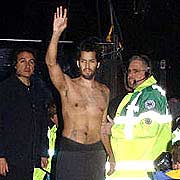
Amid a fanfare of pretentious psychobabble that made Deepak Chopra sound profound and a series of films by Harmony Korine that looked like they'd been made as part of an A-level media studies course, David Blaine was winched down from his perspex box and into the arms of paramedics -- who I sincerely hope weren't paid for out of my taxes.

For me, the stunt was summed up in the behaviour of Blaine's girlfriend, Manon von Gerkan. You would have thought she would have rushed to the aid of her boyfriend as he stepped weakly from his plastic chicken coop. But no. She stood filming the whole spectacle with her video camera -- as if there weren't enough cameras around to record the event for posterity.

If only Blaine had spent his 44 days of solitary confinement doing something worthwhile, like delivering meals on wheels to pensioners or teaching kids with autism how to count cards at the casino.

Thank God it's finally over.
A report on the landmine problem in Sudan:
UN Wire: Land Mine Accident Indicates Lurking Dangers In Sudan
Below is an article based on an interview I did for the Disability Times newspaper.

I hestitated before agreeing to do the interview because, as I've said before, I don't accept the "disabled" tag -- it's just not relevant to me and it's not something I think about.

Anyway, here it is:

Disability Times p1
Disability Times p2


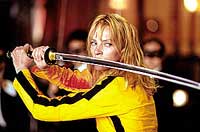
Went to see the new Quentin Tarantino film Kill Bill last night.

As well as being very entertaining, the film is a veritable amputee-fest. With her Okinawa-made Samurai sword, Uma Thurman single-handedly severs the arms, legs and heads of everyone who crosses her path (although I must say that when I lost my foot the blood didn't spray in the air like a fire hose as it does in the movie.)

Thurman's character would keep a prosthetics clinic in business for a generation.